

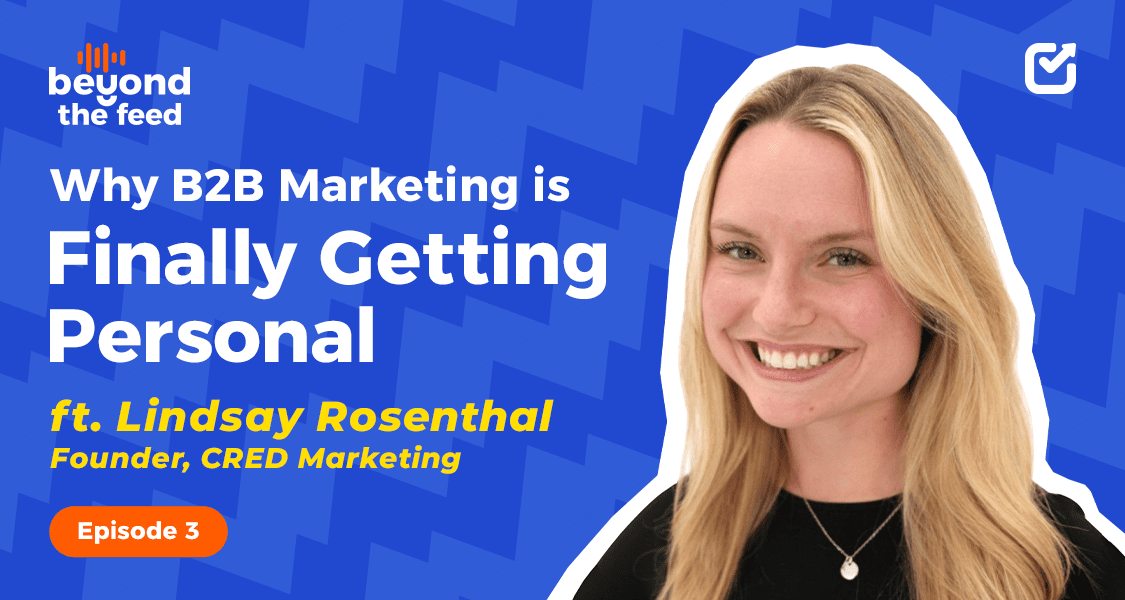
In this episode of Beyond the Feed, I sat down with Lindsay Rosenthal, founder of CRED Marketing, who works closely with global founders and executives. She believes this transformation isn’t temporary, it’s the new standard.
Watch the full episode here:
Why Is B2B Marketing Finally Catching Up With B2C?
B2C has always led the way in personality, relatability, and emotional storytelling. B2B stayed slow, rigid, and “professional.” But Lindsay explains that we’ve hit a turning point, one where personal marketing finally makes sense for B2B audiences too.
She believes this shift is happening because:
- Marketers from B2C are entering B2B, bringing creativity and EQ with them.
- AI has increased the noise, making human-centered messaging stand out.
- Modern buyers expect connection, even in business contexts.
The brands leaning into this shift are outperforming those stuck in the old templates.
Why Does Emotional Intelligence Matter So Much in B2B Now?
For years, B2B content relied on logic and features. But audiences have changed — and so has the competition. Today, B2B buyers want to feel understood, not just sold to.
According to Lindsay, emotional intelligence shows up when brands shift from:
- Static formats to dynamic, conversational content
- Generic messaging to empathetic communication
- Product-heavy narratives to people-first storytelling
With AI making it easier to build tools, it’s the emotionally smart brands that stand out.
Featured Talks: How to Automate Marketing Without Losing the Human Touch ft. Jelena B.
Can B2B Brands Use AI and Still Stay Authentic?
Many marketers fear that AI will dilute their authenticity. But Lindsay believes the real danger is not using AI at all. Used correctly, AI becomes an amplifier, not a replacement.
She explains that AI gives marketers something they never had before: scale. Instead of creating one weekly piece, they can test ideas endlessly.
AI helps marketers:
- Create multiple content variations
- Repurpose long-form into short-form
- Test messaging rapidly
- Spend more time refining than generating
But AI’s power only works when paired with:
- Real human insights
- Lived experience
- Taste and intuition
- Personal storytelling
Authenticity comes from the human behind the tool.
What AI Tools Actually Help B2B Marketers Today?
Not all AI tools elevate creativity. Lindsay prefers tools that enhance human thinking without replacing the marketer’s voice.
Some she relies on include:
- Transcription tools: to turn raw conversations into usable content;
- Opus Clip: to generate clip options that she can creatively refine
- ChatGPT: to expand ideas, but never to finalize output
The goal isn’t automation. It’s acceleration.
What Does Authenticity Really Mean in 2026?
Brands love saying they’re “authentic,” but most misunderstand the term. Authenticity isn’t about aesthetic or tone — it’s about alignment.
Lindsay defines authenticity through consistent behavior, such as:
- Saying what you mean
- Doing what you claim
- Showing up where your audience is
- Acting in ways that match your brand values
If a brand claims to be community-first yet never engages with its audience — that’s not authenticity. Authenticity is proven, not posted.
Is Personality Now a Requirement for B2B Brands?
Yes, and it’s becoming non-negotiable. Modern buyers want personality even in workplace content, especially millennials and Gen Z who influence purchasing more than ever.
Personality shows up when brands:
- Break away from generic AI-sounding text
- Add humor, tone, and cultural nuance
- Speak like real people, not corporations
- Reflect current internet behaviors
- Humanize the brand through creators and employees
The best-performing B2B content is the one that feels the least like AI.
Can Storytelling Really Work in B2B Marketing?
Absolutely, and it’s one of the most effective ways to stand out in a crowded, AI-driven content world. Storytelling reveals the human behind the brand.
Lindsay explains that storytelling works because it helps marketers share:
- Their background
- Their personal journey
- Their experiences and challenges
- Their unique perspective
- Their lived expertise
AI can generate content, but it can’t generate your story. That’s why storytelling has become a power move.
What Makes a B2B Story Truly Memorable?
Good stories spread. Great stories stick. Lindsay believes memorable B2B stories are the ones that feel fresh and original.
She says the stories that stick are:
- Different from what’s already online
- Early to the trend
- Emotionally engaging
- Visually or narratively unique
- Crafted with intention
Being the first mover matters. The 99th version of a trend rarely leaves an impression.
Should B2B Brands Participate in Trends?
B2B brands often stay cautious around trends, fearing they’ll look unprofessional or off-brand. But Lindsay believes trends can be powerful when chosen intentionally, not reactively.
She emphasizes that brands should treat trends as optional tools, not obligations.
She recommends:
- Joining trends that align with the brand identity
- Avoiding trends that don’t fit tone or values
- Balancing trends with evergreen content
- Giving teams freedom to test ideas often
Why Is LinkedIn Becoming the New B2B Powerhouse?
LinkedIn today feels like early TikTok: under-saturated, full of opportunity, and ready for breakout creators. Lindsay believes brands that show up now will dominate the next few years.
LinkedIn works so well because:
- Users are in a business mindset
- Profiles reflect real identities
- Employee posts outperform company pages
- Less than 1% of users consistently create
- Decision-makers scroll daily
It’s the perfect place for B2B brands to show personality and build trust.
Is Employee-Generated Content (EGC) the Future of B2B?
EGC is no longer a trend, it’s becoming a standard. Lindsay calls it “career insurance” for employees and a growth engine for brands.
For employees, EGC offers:
- A stronger personal brand
- A living résumé
- More visibility at work
- Access to new opportunities
- Increased expertise and confidence
For brands, EGC delivers:
- 20x more reach than corporate pages
- More trust and authenticity
- Community-led growth
- Higher engagement
Many new businesses are leading this shift, proving that empowered employees become the brand’s strongest asset.
How Can Small B2B Brands Compete With Big Players?
Today, small brands have more opportunity than ever to stand out — not despite their size, but because of it. Agility has become an advantage.
Lindsay believes small B2B companies can win by:
- Embracing founder-led content
- Posting consistently on LinkedIn
- Building direct relationships with buyers
- Creating viral, scroll-stopping ideas
- Testing formats quickly
- Keeping messaging deeply human
Distribution is free. Personality is priceless.
Which B2B Tactics Are Outdated and Should Be Retired?
Some tactics haven’t survived the shift to modern marketing — especially the traditional webinar format.
Lindsay believes outdated tactics include:
- Long, unrecorded webinars
- Sessions that feel like sales pitches
- Events with no repurposed content
- One-off webinars with no distribution plan
Modern webinars must educate, not push. And they must live beyond the live event.
Does Community Building Matter in B2B?
Community isn’t just a B2C advantage anymore, it’s a major lever in B2B growth. Buyers want to feel included, connected, and valued.
Lindsay points to brands like Clay, which excel because they build communities that offer:
- A sense of belonging
- Access to shared knowledge
- Identity and alignment
- Real engagement
- Emotional loyalty
Community creates stickiness. Stickiness creates growth.
Featured Talks: How to Beat the Algorithm Without Burning Out ft. Michaela Brewer
Can B2B Brands Use AI and Still Stay Authentic?
How Much Should B2B Marketers Rely on Intuition vs Data?
With dashboards and analytics everywhere, data has become expected — not exceptional. Lindsay believes the real differentiator is taste.
She sees today’s best marketers balancing:
- Data-backed decisions
- Cultural intuition
- Creative instincts
- Lived experience
- Fast-paced experimentation
- Smart risk-taking
Anyone can read data. Few can interpret it well.
How Can B2B Brands Stand Out in an AI-Crowded Market?
With new tools appearing daily, differentiation comes from originality, not volume. The brands that stand out know how to lean into what makes them unique.
Lindsay believes brands can differentiate by:
- Building a distinct voice
- Leading with personal stories
- Showing up in real-life activations
- Building communities
- Offering strong product experiences
- Staying consistent
- Moving quickly on ideas
Being different beats being louder.
Final Takeaway
Lindsay ended with two lessons every B2B marketer should hold onto:
- Use AI. Test constantly.
- But lead with your own taste, intuition, and lived experiences.
AI multiplies output, not identity. Your story is the strategy.
In the end: B2B buyers don’t connect with brands. They connect with the humans behind them.