

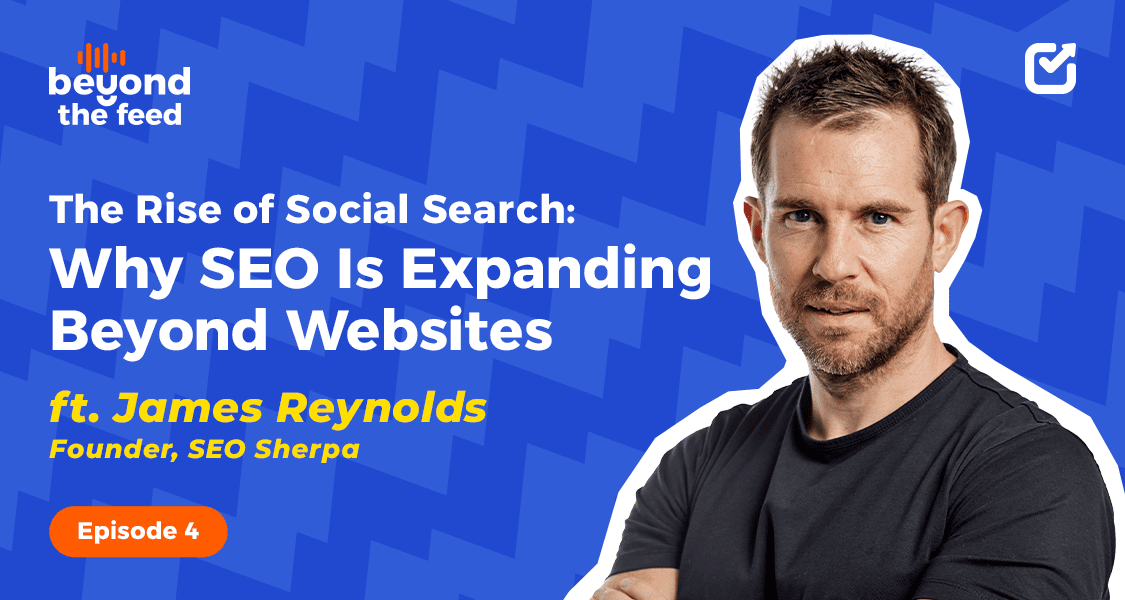
I recently sat down with James Reynolds, the Founder and CEO of SEO Sherpa, for an episode of Beyond the Feed, and what started as a conversation about SEO quickly turned into a deep exploration of how search behavior has completely transformed.
As James explained, SEO today isn’t just about Google anymore. People are now searching across TikTok, Instagram, YouTube, LinkedIn, Amazon, AI tools like ChatGPT and Perplexity, and of course, the traditional engines. And if brands aren’t showing up everywhere people search, they’re losing influence across the entire buying journey.
Let me walk you through the key takeaways from our conversation.
Watch the full episode here:
Search Is Happening Everywhere Now
When I asked James why SEO is moving toward social search, he made one thing clear: people no longer rely on one platform for answers.
We’ve entered an era of diversified search behavior. A user may discover a trending product on TikTok, read reviews on Amazon, learn more on Google, and watch explainer videos on YouTube, all before making a decision.
Because of this, James said we should stop thinking of SEO as “Google optimization” and start thinking in terms of Search Everywhere Optimization.
If our audience is searching on TikTok? We need to show up there.
Searching on YouTube? We need to show up there, too.
Searching through AI tools? We need to be included in those data ecosystems.
The buying journey isn’t linear anymore, and our visibility shouldn’t be either.
The Role of SEOs Has Changed (and Expanded)
I asked James whether SEO professionals now have more on their plates. His answer: Absolutely!
For years, SEO was almost synonymous with “ranking on Google.” Today, it’s about understanding and optimizing content for multiple search-driven platforms, each with its own algorithm and user intent.
But he also reminded me that AI helps lighten the load. It can process large datasets, automate repetitive tasks, and help SEOs work smarter. Still, AI can’t replace strategy, creativity, or human judgment.
In short, the job is bigger, but the tools are better.
Do Social Platforms Have Their Own Version of E-A-T?
I asked James whether concepts like Google’s E-A-T also apply to social platforms. His answer was, ‘Yes, just in different forms.’
Social platforms reward:
- Expertise (showing authority early in the video)
- Watch time
- Engagement
- Relevance to what people are searching
- Audience retention
He explained something really interesting. When you demonstrate authority in the first few seconds, for example, “I’ve spent 15 years doing SEO…” viewers are more likely to stick around. That increased dwell time helps the algorithm understand that your content is valuable and should be surfaced more often.
And of course, including your keyword in the title, captions, descriptions, and even spoken words gives algorithms the context needed to rank your content in social search.
Finding Keywords for Social Search
Traditionally, keyword research meant tools for Google or Bing. But now, brands need to understand what people are searching across TikTok, Instagram, YouTube, and even AI systems.
James recommends Keywordtool.io because it shows keyword data for:
- Bing
- Yahoo
- TikTok
- YouTube
- And newer AI-driven engines like Perplexity
He explained how this helps pinpoint exactly where your audience is searching, which tells you where your content efforts should go.
Ranking on LLMs: Brand Mentions Matter
One of my favorite parts of our conversation was about LLMs (like ChatGPT) and how brands can show up in AI-generated answers.
According to James:
- LLMs rely heavily on web-crawled data
- To even be considered, you must be indexed, visible, and reputable online
- The biggest factor? Brand mention frequency, especially alongside relevant keywords
For example, his agency wants to be mentioned frequently alongside searches like “SEO agency,” “best SEO agency,” or “content marketing agency.” The more consistent and contextually relevant those mentions are, the more likely an LLM will associate your brand with those concepts.
He also stressed the importance of consistent branding across all social platforms, which includes bios, taglines, descriptions, and everything.
And since LLMs value freshness, your recent social content can actually appear inside AI responses, especially in Google’s AI Overviews.
Do More Videos Mean Better Social SEO?
When we shifted to short-form video, I asked whether frequency still matters the way blog frequency used to for SEO.
James’ answer was refreshing:
“Less but better.”
He emphasized that quality matters far more than volume. You should create videos that clearly answer a search query and provide value, uniquely and creatively.
If you can produce both better and more, great. But pumping out content just to publish will get you nowhere.
The key is high-quality, useful content, not AI-generated filler.
Reddit, Brand Mentions, and Changing AI Citations
A lot of marketers online claim Reddit is becoming essential for AI rankings. So I asked James if Reddit really matters more in the age of AI.
Surprisingly, he said Reddit citations have actually dipped sharply in recent weeks, which proves how unstable platform dominance can be.
Instead, he encouraged focusing on:
- Strong brand sentiment
- Authentic conversations across multiple platforms
- Diverse mentions, not just one source
As he put it, building your castle on one platform is dangerous. Algorithms change overnight.
Misconceptions Marketers Still Have
When talking about SEO on social media, James said one major misconception still exists:
“People think social engagement directly boosts Google rankings.”
It doesn’t, at least not directly.
Google can’t fully access social signals because much of that data is private or restricted. The correlation between highly shared content and high rankings doesn’t mean causation — it just means the content itself is good, and both audiences and search engines recognize that.
What is changing is that more social content is showing up directly in traditional search results for TikToks, YouTube Shorts, and even LinkedIn posts.
Can SEO Content Be Creative? Absolutely!
I asked James whether SEO content has to be boring. Thankfully, he said what I’ve always believed: it doesn’t.
Relevancy doesn’t mean dullness.
You can answer a question while still being:
- Creative
- Bold
- Funny
- Unique
- Visually engaging
In fact, being unique is the only way to stand out. If you simply create content that already exists, you’ll always be second-best.
Match the format people want: video, text, graphic, and then bring your own perspective and creativity to make it memorable.
The Future of SEO: Technical + Human
When discussing the future of SEO, James mentioned that both technical and human-centered approaches will remain essential.
Yes, your content needs to be:
- Crawlable
- Fast
- Well-structured
- Indexed
But it also needs to:
- Speak to real people
- Match human search behavior
- Provide unique value
The future, he says, is more personalized, more diversified, and more interconnected across platforms.
SEO specialists will evolve into holistic marketers, part creator, part strategist, part analyst.
James’ Final Advice for SEO Professionals
As we wrapped up, I asked James what advice he would give to anyone doing SEO, especially for social media.
His answer was simple:
“Test a lot. Create more. Don’t just consume. Execute.”
Momentum creates learning. Action creates insights. Put your ideas into the world, and then adjust based on what you learn.
Final Thoughts
Talking to James made one thing crystal clear: SEO is no longer a Google-only game. It’s woven into every digital platform we use today, including social networks, AI models, video platforms, and more.
If search is happening everywhere, then our optimization efforts need to happen everywhere, too.
And the brands that embrace this shift early will lead the next era of visibility, influence, and digital growth.