
Have you ever seen a video that you cannot quit halfway through?
And does it make you want to create similar videos that just hook the viewer until the end?
I feel the same, but it’s not as easy as it seems, is it?
Social media hook is harder to get than people consider it to be.
Short Summary
- Attention spans are extremely short, making strong hooks essential for keeping viewers engaged.
- Effective hooks combine curiosity, relatable problems or benefits, and a sense of urgency.
- Simple templates and categorized examples can help creators craft strong hooks quickly.
- Engagement metrics like 3-second views, watch time, and “read more” clicks reveal hook performance.
- Analytics tools can simplify tracking, highlight winning hooks, and optimize posting times.
Now, when the average human attention span is less than 9 seconds, it is extremely difficult for creators to convince their audience to stay.
I myself doomscroll Instagram endlessly and hardly give any video more than 5 seconds to grab my attention, and this is the case for countless people.
While the algorithm brings the content to us, it’s the creator’s responsibility to keep us hooked throughout the video.
So what makes me and everyone else stay? The right social media hook!
In this blog, I’m going to tell you everything you need to know to get the best social media hook for your content.
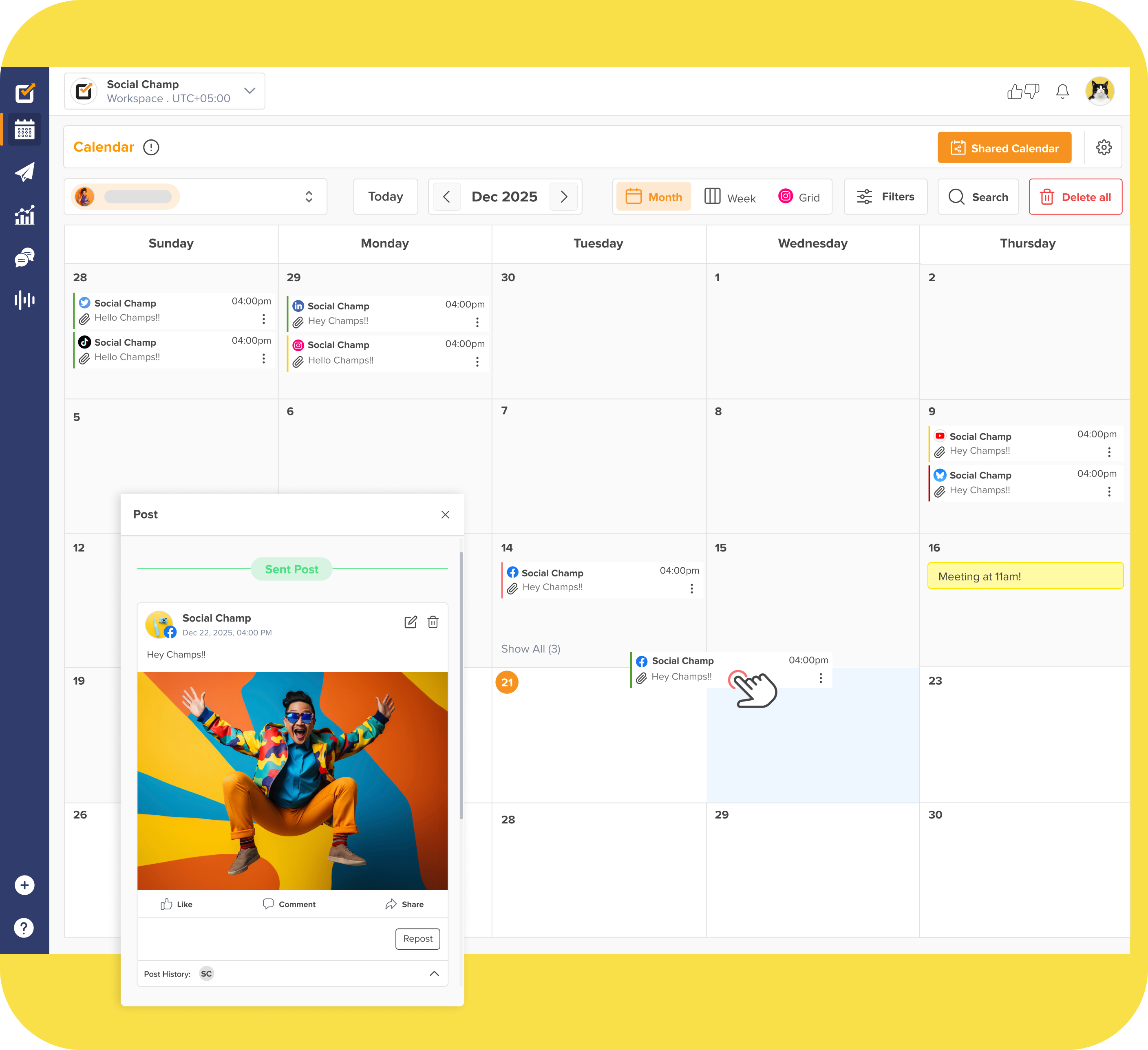
Everyone has formulas. Few have proof. Use Social Champ to see which hooks actually stop the scroll, then outsmart your competition.
Why Is Having a Hook for Social Media Important?
I’ve been there, you spend three hours editing the perfect video or writing a caption that’s pure gold, you hit post, and then… crickets.
But here’s the cold, hard truth I’ve had to learn: on social media, it doesn’t matter how great your “middle” is if nobody stays past the first two seconds.
If you walk up to someone and just start mumbling about your day, they’re going to walk away. This is exactly the case with social media.
We’re living in an attention economy. People aren’t just scrolling; they’re speed-scrolling to find a reason to stop.
Your hook is that reason. Without it, even your best ideas just become digital noise.
I like to think of it like a movie trailer. You don’t need to tell the whole story in the first three seconds, but you definitely need to make me want to buy the popcorn.
If you can master the hook, you’ve already won 80% of the battle.
I hope this clarifies why you need a hook for social media!
Featured Article: What You Can Learn from Rare Beauty Marketing in 2026?
Social Media Hook Formula That Will Stop the Scroll
I used to think that writing a great hook was just about being lucky or “vibey,” but once I started looking under the hood, I realized there’s actually a bit of a science to it.
You don’t have to reinvent the wheel every time you post. In fact, I’ve found that almost every viral post follows a pretty simple three-part recipe.
If you want to stop the scroll dead in its tracks, try using this formula: The Curiosity Gap + The Relatable Pain (or Gain) + The Urgent Command.
Here’s how I break that down:
- The Curiosity Gap: Start with something that feels incomplete. If you tell them the whole story in the first sentence, they have no reason to stay. I like to start with phrases like, “I found the one tool that…” or “Most people think X, but actually…” It creates a “loop” in their brain that only your content can close.
- The Relatable Pain (or Gain): You have to make them feel seen. I try to lean into a specific struggle we’ve both had. Instead of saying “How to save money,” I’ll say, “I was tired of looking at my bank account and seeing $0 every Monday.” Now, we’re bonding over a shared problem.
- The Urgent Command: Give them a reason to keep watching right now. Use words that imply speed or secrets, things like “Stop doing this,” “Watch until the end,” or “The secret is in the last slide.”
Pro Tip: To make it easy, you can usually plug your ideas into a template like this:
[Big Result] + [Short Timeframe] + [Without the Thing They Hate] Example:
“How I grew 10k followers in 30 days without spending a cent on ads.”
List of Hooks for Social Media You Can Use
Honestly, some days the brain just isn’t “braining.” That’s why I love having a “cheat sheet” of proven hooks tucked away.
I’ve categorized these for you so you can grab whichever one fits the vibe of your post. Feel free to copy and paste these and tweak them to suit your niche!
-
Hooks for Curiosity
These are perfect for when you want to challenge the status quo or share a secret.
- I was today years old when I found out [Topic].
- Stop [Doing Common Action] if you want [Desired Result].
- This is the one thing nobody tells you about [Industry/Topic].
- I tried [Trend] for 30 days, so you don’t have to.
-
Hooks for Relatability
I use these when I want to build a real connection with my audience. It’s like saying, “Hey, I’m in the trenches with you.”
- Is it just me, or is [Common Struggle] getting harder?
- POV: You’re tired of [Problem] and finally decided to do something about it.
- I used to struggle with [Problem] until I discovered this.
- If you’re a [Role, e.g., Freelancer/Mom/Gamer], you need to hear this.
-
Value-Driven Hooks
These work wonders because they promise an immediate reward for staying tuned.
- Steal my 3-step routine for [Result].
- How to [Goal] in under 60 seconds.
- 3 tools that feel illegal to know for [Topic].
- The lazy way to get [Result] without [Pain Point].
-
Hooks for Engagement
If you’re doing video (like Reels or TikTok), these text-overlay hooks are gold.
- Watch me turn [Bad Thing] into [Good Thing].
- The last tip is the only one that actually worked for me.
- Don’t scroll! You’re going to want to save this for later.
Pro Tip: I’ve noticed that if I use a “Negative Hook” (like “Stop doing this”), it often performs better than a positive one. We’re naturally wired to want to avoid mistakes more than we want to gain benefits!
Featured Article: How to Batch Instagram Posts for Q1 Before the Holidays?
Examples of Social Media Hooks
It’s one thing to look at a formula, but I always find it’s way easier to get it when you see it out in the wild.
Here are some examples of good social media hooks!
Like this video by @gaurikagandhi, where she’s talking about a dream she had, it automatically intrigues interest, and once you continue to watch it, you realize it’s not really about the dream!
View this post on Instagram
Another example of a great hook is this video by @looksbyhala, where she’s promoting a product but starts by saying that it’s sold out!
View this post on Instagram
Now let’s talk about subtle hooks that generate curiosity, like this video by @chapterofiris.
View this post on Instagram
This hook is the perfect example of how you can motivate your audience to watch the video till the end without thinking too hard about the hook!
Just start with something that will make them feel good about themselves.
You can also choose to go the fun route. Think about the ways you can make your content fun while also keeping the message intact.
Take this video as an example, where @thenictionary is teaching you how to edit your videos on CapCut but in a fun way!
View this post on Instagram
How to Know If Your Hook for Social Media Is Working?
So, you’ve started using these formulas, and you’re feeling like a total pro, but how do you actually know if they’re hitting the mark?
I used it just to check my likes and call it a day, but honestly, likes can be a bit of a vanity metric. If you want to know if your hook is truly stopping the scroll, you have to look a little deeper.
-
The Metrics That Actually Matter
When I’m auditing my own posts, I look for three specific signs that the hook did its job:
- The 3-Second View Rate (for Video): This is the ultimate “Hook Score.” If people are dropping off before the 3-second mark, your hook didn’t grab them. If they stay past it, you’ve officially stopped the scroll.
- Average Watch Time: A great hook doesn’t just start the engine; it keeps the car moving. If your hook promised a secret, and your watch time is high, it means you successfully opened the curiosity gap and held it.
- The “Read More” Click (for Captions): On platforms like Instagram or LinkedIn, your hook is often just the first sentence. If people are clicking that tiny “more” button, your hook worked!
-
Stop Guessing with Social Champ
I’ll be real with you, trying to track all of this manually across five different platforms is enough to give anyone a headache. This is where Social Champ becomes your secret weapon.
I love using their advanced analytics because it takes the guesswork out of the equation.
Instead of jumping from app to app, you can see exactly which hooks are performing best across all your accounts in one dashboard.
Here’s why I think you’ll love it:
- Identify Top-Performing Posts: You can sort your posts by engagement, clicks, or shares to see which specific “hook style” your audience is vibing with.
- Weekly & Monthly Reports: It creates these beautiful, easy-to-read charts that show you if your reach is actually growing over time.
- The Best Time to Post: Even the best hook can fail if you post it when your audience is asleep. Social Champ tells you exactly when your followers are most active, so your hook gets the “prime time” slot it deserves.
Pro Tip:I like to use Social Champ to recycle my best-performing hooks. If a post did amazing three months ago, I’ll tweak the hook slightly and schedule it to go out again. It’s a total lifesaver for those days when the creative juices aren’t flowing!
Likes won’t tell you anything. Social Champ reveals the metrics that matter, so you can create content people actually stay for.
Featured Article: Worst Social Media Strategies That Kill Brands
Conclusion
I know it feels like a lot to juggle, but honestly, once you start thinking in “hooks,” you can’t un-see them.
I’ve realized over time that you don’t need to be a professional copywriter or a viral sensation to make this work; you just need to be intentional about those first few seconds.
Remember, your content is awesome, you just have to give people a reason to realize it!
Start small: pick one of the formulas we talked about, try it on your next post, and then head over to your analytics to see what happened.
Social media changes every single day, but the way our brains respond to curiosity, relatability, and value?
That’s pretty much hard-wired. You’ve got the tools, the formulas, and the cheat sheet; now you just have to hit post.