
Mission-driven Marketing is one of the most misunderstood disciplines in the industry. It doesn’t follow the same rules as B2C or B2B. There’s no product to sell, no discount to offer, and no direct ROI to point to. What there is, when done right, is a story powerful enough to move people to act and a social media tool for nonprofit organizations can help amplify that story to reach the right audience at the right time.
In this episode of Beyond the Feed, Aiman sits down with Tiffany Simmons, Strategic Global Storyteller and Manager of Digital Growth at Boys and Girls Club of America, to unpack what marketing actually looks like when the mission is the message.
Key Podcast Takeaways
- Why non-profit marketing is fundamentally different from for-profit
- How to tell a mission-driven story without it sounding like a funding pitch
- How to manage tight budgets without sacrificing marketing impact
- Why data and the human element aren’t opposites
- How Boys and Girls Club of America uses its kids as its most powerful ambassadors
- What content mix actually works for non-profits across different platforms
- How to build a year-round community of active supporters
- The one marketing lesson Tiffany learned late that every non-profit marketer needs to hear
- How to stand out in a crowded content landscape when you can’t outspend everyone else
- Practical tips for becoming a better storyteller
Watch full podcast here:

Is Non-Profit Marketing Really That Different From Regular Brand Marketing?
Yes, non-profit marketing is quiet different from other brand marketing. And understanding that difference is the starting point for everything else.
In for-profit marketing, you’re selling a product or service. There’s a transaction at the end. In non-profit marketing, there’s no product, no price point, and no direct exchange. What you’re selling is belief, in a mission, in an impact, in a cause worth supporting.
The end goal, a donation, a volunteer sign-up, a partnership, only happens when someone feels connected to what you’re doing. That emotional connection is not a nice-to-have. It’s the entire strategy.
How Do You Tell a Non-Profit’s Story Without It Sounding Like a Funding Pitch?
This is the central challenge of non-profit marketing, and the answer lies in how you frame the story, not just what story you tell.
The instinct for many non-profits is to lead with need. The problem is that leading with pain, poverty, or urgency can make audiences feel manipulated rather than moved. Tiffany’s approach at Boys and Girls Club is the opposite, lead with strength.
For Boys and Girls Club, that means:
- Showing what the kids are doing and achieving, not just what they lack
- Connecting impact to story, the meals, the safe spaces, the opportunities, through the lens of a real person’s experience
- Making the donor or supporter feel like they’re part of something positive, not just responding to a problem
Storytelling at this level is genuinely difficult. Even experienced marketers are still learning how to do it well. The key is treating it as an art form that requires constant refinement, not a checkbox to tick.
Featured Talks: What an AI-Powered Marketing Strategy Looks Like ft. Roisin Bennett
How Do Non-Profits Manage Marketing on a Limited Budget?
Budget constraints are a reality for almost every non-profit. Marketing is often the first line item cut when finances get tight — which makes smart allocation even more important.
Tiffany’s approach comes down to three principles:
Prioritise ruthlessly
Not every channel, campaign, or initiative deserves budget. At the start of each year, look at what performed in Q4 and use that data to decide where to invest more and where to pull back.
Think beyond spend
For Boys and Girls Club, with 5,500 clubs across the country, budget isn’t always the answer. Sometimes the smarter move is tapping into existing assets ,the clubs themselves, the communities, the partners, rather than reaching for the budget.
Month 12+
Non-profits have partners, brands, sponsors, community organisations, who share aligned missions. The goal isn’t just to promote the partner; it’s to find the overlap where both messages get amplified at the same time. That’s where budget goes further.
Should Non-Profit Marketers Follow the Data or Trust Their Instincts?
Both — but they work best when used together, not in competition.
Data tells you what’s working, what isn’t, and where to allocate your next move. It improves targeting, sharpens messaging, and removes guesswork from content decisions. For a resource-constrained non-profit, data-informed decisions are essential.
But data alone produces cold marketing. And cold marketing doesn’t raise money.
The human element — the faces, the stories, the personalities behind the organisation — is what builds the trust that eventually converts to action. The sweet spot is using data to shape your strategy and human insight to bring it to life.
Numbers tell you what to say. Humanity tells you how to say it in a way people actually care about.
Who Makes the Best Ambassador for a Non-Profit — Staff, Influencers, or Someone Else?
For Boys and Girls Club, the answer is clear: the kids themselves.
Not because it’s the obvious or convenient answer, but because they are genuinely the most authentic representation of what the organisation does. They’re in the clubs every day. The impact is real and visible in their lives. No influencer partnership or staff spokesperson can replicate that credibility.
The lesson here extends to any non-profit: your best ambassador is whoever most authentically lives the mission. That’s not always the founder, the executive director, or the most polished spokesperson. It’s the person whose life has been most visibly changed by what your organisation does.
Find that person. Tell their story. Let them speak.
What Content Mix Actually Works for Non-Profit Organisations?
Non-profits don’t need to reinvent content strategy, they need to adapt the same principles that work for any organisation while staying true to their mission.
Tiffany’s approach at Boys and Girls Club:
Mix formats intentionally, not randomly:
- Instagram still favours carousels, but video performs well there too
- TikTok gets different content, more raw, more spontaneous
- LinkedIn skews toward thought leadership and impact reporting
- Photos and videos are intermixed across all platforms
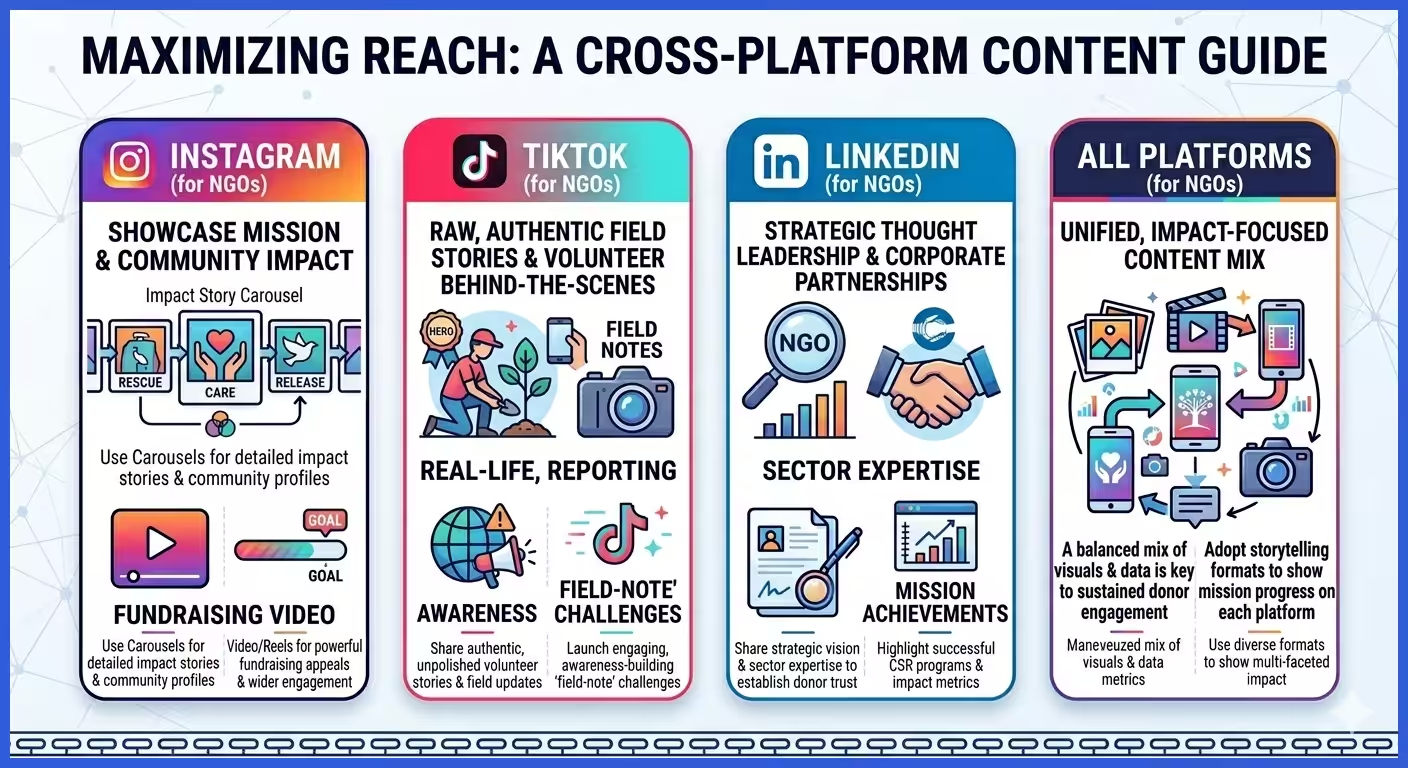
Here are the two mistakes you need to avoid when creating content pillars for non-profit organizations:
Tailor by platform, not just by format
What works on Instagram won’t necessarily work on TikTok. Each platform has its own tone, pace, and audience expectations. Treating them all the same leads to content that feels off everywhere.
Avoid overloading any single format
When an organisation produces the same type of content repeatedly, audiences disengage. Variety keeps the feed fresh and ensures you’re reaching people through different entry points.
Featured Talks: Why Creator Campaigns Fail And What Brands Need to Do Differently ft. Tara Knight
How Do Non-Profits Build an Active Community, Instead of Just a Following?
Community building for non-profits is a two-way commitment — and that distinction matters.
Many organisations approach their audience as recipients of content. Post, broadcast, repeat. But a community is built on dialogue, not monologue. For Boys and Girls Club, the core community is parents — working parents who need after-school care, safe spaces, and support for their kids.
Tiffany’s framework for building that community:
Meet them where they are
Don’t expect your audience to come to you on your terms. Show up in the spaces, platforms, and conversations they’re already in.
Listen actively
What are your supporters asking for? What feedback are they giving? What are they sharing with their own networks?
Close the loop
When your community gives you feedback, respond to it in your content. Show them you heard what they said. That’s what makes people feel like they belong, not just that they follow.
When supporters feel genuinely heard, they don’t just stay, they become advocates. They share your content with their own networks. That’s how non-profit communities actually grow.
What Should Someone Do Before Starting a Non-Profit, Especially Online?
For anyone thinking about launching a non-profit, Tiffany’s advice is direct: get grounded before you get visible.
Building an online presence before you’re clear on your mission is building on sand. The foundation has to come first.
Before you post anything:
- Be able to explain what your non-profit does in 30 seconds or less, clearly, simply, to anyone
- Understand the specific need your organisation is filling. Not a general cause, but a specific gap that currently isn’t being addressed
- Get hands-on experience first. Volunteer at similar organisations. Understand the space from the inside before trying to lead within it
Before you post anything:
- Be able to explain what your non-profit does in 30 seconds or less, clearly, simply, to anyone
- Understand the specific need your organisation is filling. Not a general cause, but a specific gap that currently isn’t being addressed
- Get hands-on experience first. Volunteer at similar organisations. Understand the space from the inside before trying to lead within it
What’s the One Marketing Lesson Every Non-Profit Marketer Learns Too Late?
This is one of the most common traps in non-profit marketing, and honestly, in marketing broadly. The instinct is to tell the full story, add all the context, explain all the nuance. But the more you say, the more your audience has to work to find what matters.
In practice, that means:
People move fast. If your message requires six paragraphs to land, you’ve already lost most of your audience. The most powerful non-profit content is often the simplest, a single image, a two-line caption, a 30-second video clip that says everything without saying too much.
How Does a Non-Profit Stand Out When There’s So Much Content Clutter Online?
The answer isn’t to produce more content. It’s to produce more focused content.
The temptation when you’re being drowned out is to cast a wider net, jump on trending formats, replicate what other organisations are doing, chase whatever seems to be working elsewhere. But that approach homogenises your content and makes you indistinguishable.
The path to visibility is specificity:
Double down on your unique story, not a version of everyone else.
Stay in your lane, the organisations that build the most loyal communities are the ones that are known for one thing done exceptionally well
Trust that the right content will reach the right people, and those people will share it with their networks
job isn’t to reach everyone. It’s to deeply resonate with the people who matter most to your mission.
Featured Talks: Are 2016 Marketing Trends Actually Back And Should Your Brand Care ft. Katerina Stasiukevich
Do Non-Profits Need Campaigns or Is Ongoing Content Enough?
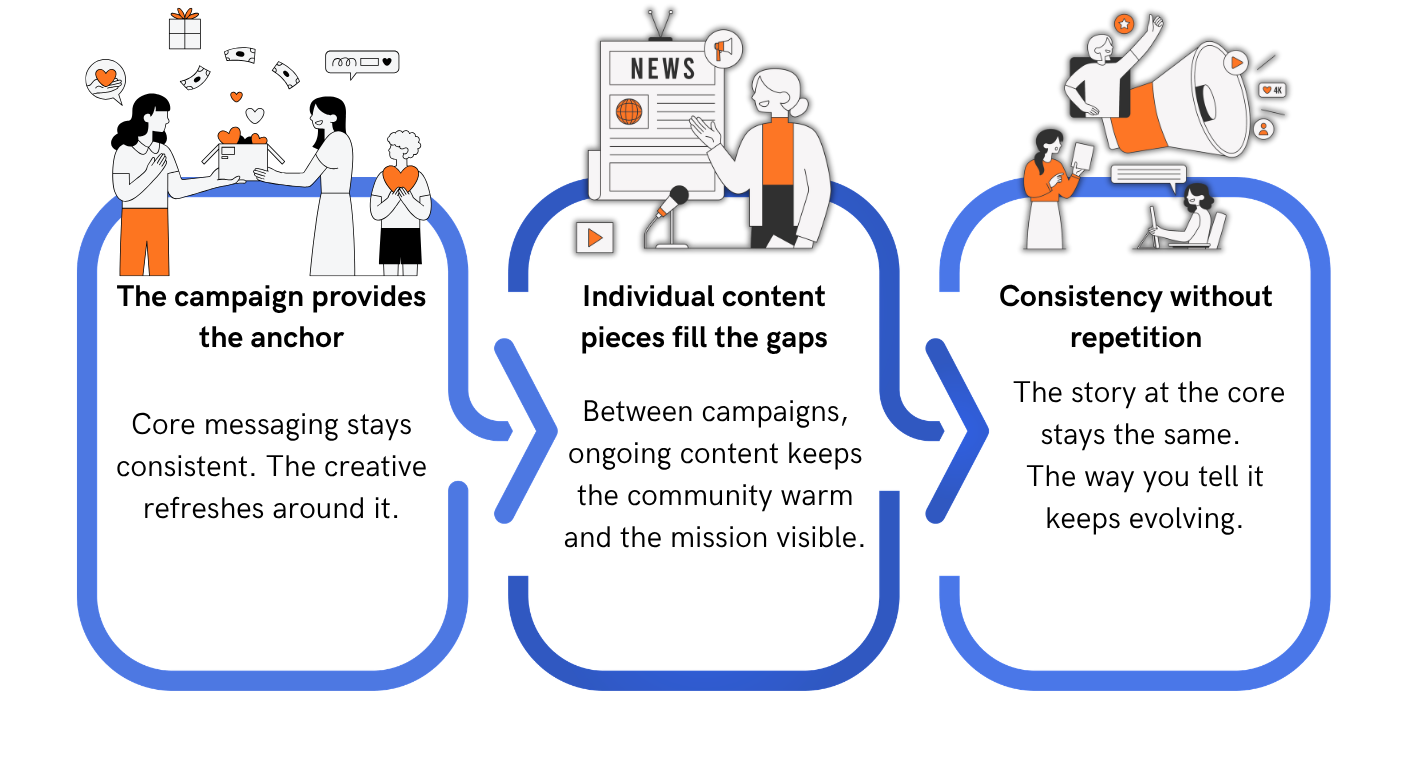
Non-profits need both campaigns and ongoing content. In fact, the best non-profits treat campaigns as the spine that holds ongoing content together.
At Boys and Girls Club, they run four national campaigns per year, what Tiffany calls “360s.” Every piece of content, every creative asset, every influencer activation ladders up to that central campaign message. Nothing exists in isolation.
This is the for-profit playbook applied to the non-profit context:
How Do You Tell a Story Well? Three Tips From Tiffany
Storytelling is a skill, and like any skill, it can be developed. Tiffany breaks it down into three practical steps:
Know the person, not just the story
Before you write a single word, immerse yourself in the full story of the person you’re featuring. Read everything. Listen carefully. The small details you might otherwise miss are often the most powerful parts of the story.
Walk away before you finalise
After you’ve created the content, step away from it completely. When you come back with fresh eyes, you’ll see what you missed, what’s unclear, and what’s actually worth keeping. Distance gives you objectivity.
Lean on your team
What feels like the most important moment in a story to you might not be what resonates most with your audience. A second perspective, or a third, will surface angles and takeaways you couldn’t see because you were too close to it.
How Do Non-Profit Marketers Deal With Emotional Burnout?
Burnout is an industry-wide challenge. For non-profit marketers, it’s compounded by the emotional weight of the work itself. You’re not just managing content calendars, you’re carrying other people’s stories, sometimes difficult ones, every single day.
Tiffany’s approach is twofold:
Set hard boundaries
When the workday ends, it ends. Close the laptop. Put the phone down. Reconnect with the people and activities that refill your energy. Being always-on doesn’t make you a better marketer , it makes you a depleted one.
Build a strong team
At Boys and Girls Club, the marketing team operates as a genuine collective. When one person is running low, others carry the load. That shared responsibility doesn’t just reduce burnout, it actively energises the team because creativity is contagious. Being surrounded by people who are invested and generating ideas lifts everyone.
Featured Talks: How Can Founders Build a LinkedIn Growth Strategy That Drives Leads? ft. Niall Ratcliffe
Final Word from Tiffany
Non-profit marketing is one of the most challenging, and most rewarding, disciplines in the field. The constraints are real. The emotional weight is real. But so is the impact.
When what you post today actively helps someone tomorrow, the work means something that a product launch or a sales campaign rarely can. The marketers who thrive in this space are the ones who stay curious, stay humble, and never stop learning how to tell a better story.