A social media crisis is a nightmare for all social media managers.
Weeks and months go into planning posts and events, but one mistake can blow it all up!
The worst part is not the crisis itself, I mean, it’s not uncommon to mess it up a lot, even big brands like Pepsi mess up their campaigns sometimes.
Short Summary
- Effective crisis management begins with pausing all scheduled posts and actively listening to what people are saying across platforms.
- Bringing together a crisis response team (marketing, PR, legal) ensures aligned messaging and quick decision-making.
- Follow-up engagement must be calm, consistent, and professional without arguing or deleting genuine criticism.
- Examples of major crises include the Astronomer CEO scandal, OceanGate’s communication failure, and Volkswagen’s controversial April Fool’s ad.
- Tools like Social Champ help brands track mentions in real time, pause scheduled posts instantly, and manage all messages from a unified inbox.
The bigger problem is the aftermath. The way you handle the crisis is what makes your brand stand out, and that is exactly what I’m going to expand upon in this blog.
With reputation management and social listening, you can track your brand mentions and know what everyone thinks and says about your new campaign. But that’s just a part of crisis management.
Let’s dig deep to know how to manage a social media crisis without messing up!
Own the Narrative Before It Owns You!
When conversations spark, jump in instantly. Social Champ helps you shape the story before the crowd does.
What Is Social Media Crisis Management and Why Does It Matter?
Let me clear one thing: a typo in your social media post is NOT a social media crisis!
It’s not that small; a social media crisis is generally something that you cannot foresee.
It can be anything that causes a sudden, massive wave of negative attention and public conversation across social platforms.
- It’s Fast: It spreads like wildfire. What starts on one platform can quickly jump to others (Twitter to Instagram to TikTok, and so on).
- It’s Serious: It has the potential to seriously damage your brand’s reputation, impact sales, and maybe even scare off future customers.
- It’s Uncontrolled: The narrative is no longer yours. Thousands of people are now talking about you, and the conversation is happening without your permission or control.
Do you remember that Pepsi ad featuring Kendall Jenner that was pulled down due to social justice issues and protests? That’s one example of a social media crisis.
Featured Article: Why Your Brand Image Is Important on Social Media?
What Are the Common Types and Triggers of Social Media Crises?
Not all fires start the same way!
When it comes to a social media crisis, the trigger can come from inside your brand or completely out of the blue.
Knowing the common culprits helps you prepare your defenses. Generally, we categorize triggers into a couple of main groups:
Internal Triggers
These are issues that start because of an action, decision, or mistake made by your brand, your employees, or your partners. These are the ones you have the most control over!
- Product Failure/Service Issues: Your main product breaks, your app goes down for hours, or your customer service team is unresponsive.
- Insensitive Content/Tone-Deaf Posts: Your social media team publishes a post that is sexist, racist, culturally insensitive, or simply uses an inappropriate tone during a serious national event.
- Employee/Influencer Misconduct: A high-profile employee makes a controversial statement, or an influencer you hired behaves inappropriately while promoting your product.
- Data Breach/Security Failure: Customer data is compromised, leading to major trust issues and potential legal headaches.
External Triggers
These are events that happen outside your direct control but still manage to suck your brand into the negativity vortex.
- Platform Outage: A major platform (like X or Instagram) goes down, and customers vent frustration about their inability to access your service via that platform.
- Third-Party Activism: Social or political movements use your brand (or its known affiliations) as a target for protests, boycotts, or negative campaigns.
- Negative Media Coverage: A journalist publishes a highly critical report about your business practices, which then goes viral on social platforms.
- Emergent Trend Catch-Up: A new TikTok trend surfaces where people are using your product incorrectly or making fun of your branding, forcing you to respond.
This is exactly why your Social Champ listening feature is so vital!
It doesn’t just catch your mistakes; it acts as an early warning system for those third-party, external triggers, giving you a chance to prepare a response before the wave hits your mentions.
Here is a breakdown of common triggers to help you visualize the threat landscape:
| Trigger Type | Example Scenario | Speed of Escalation | Key Platform(s) Affected |
|---|---|---|---|
| Product Failure | A new software update erases customer data. | Very High (Immediate) | Twitter (X), Reddit (Tech & Industry Specific), Facebook |
| Insensitive Post | A scheduled joke goes out on the anniversary of a tragedy. | Extremely High (Minutes) | Twitter (X), Instagram (High Visibility) |
| Influencer Misuse | A brand ambassador is caught on video acting illegally. | High | Instagram, TikTok, YouTube (Visual Platforms) |
| Service Outage | Your e-commerce website is down for 8 hours on a major sale day. | High | Twitter (X) (for immediate updates), Customer Support Channels |
| Data Breach | Customer emails and passwords are leaked. | Medium (Waiting for confirmation/news) | News Outlets, Facebook, LinkedIn (Trust Platforms) |
| External Event | An activist group protests your company’s supply chain partner. | Medium to High (Depending on media pickup) | Twitter (X), Facebook, TikTok (Viral Spread) |
How Do You Detect a Social Media Crisis Early?
The best defense is a great offense! Detecting a crisis early is less about luck and more about having the right tools and knowing what signs to look for.
You want to spot the smoke before the five-alarm fire starts.
-
Invest in Constant Monitoring
You can’t rely on manually checking your mentions every hour; that’s exhausting!
I rely heavily on social media listening and monitoring tools (like Social Champ, or similar platforms) to act as my digital watchdogs.
These tools constantly scan the social web for keywords related to your brand, products, and industry.
What are these tools looking for?
- Volume Spikes: They alert you when the sheer volume of mentions about your brand suddenly jumps by an abnormal amount. If you usually get 50 mentions an hour and suddenly get 500, that’s a red flag.
- Sentiment Shifts: This is the most crucial part! The tool tracks the sentiment (positive, negative, or neutral) of those mentions. If you see a sudden X% increase in negative mentions (say, a jump from 5% negative to 30% negative) over a short time, you know trouble is brewing.
- Trending Keywords & Hashtags: They identify any new, negative, or critical hashtags that are starting to trend specifically about your company or a recent action.
-
Your Initial Detection and Assessment Checklist
Once your monitoring tool screams “Alert!” you need a fast, simple process to decide what to do next.
Your management platform (like Social Champ) helps here by centralizing all those mentions and alerts, so you don’t have to jump between networks to verify the source.
Step Action Goal Alert Receive the Notification. (From a social listening tool based on pre-set thresholds.) Immediately stop all scheduled posting and gather the core crisis team. Assess Verify the Threat. (What is the core issue? Is it credible? Is it viral yet? Which platform is the source?) Determine if the event meets your pre-set crisis threshold criteria. Escalate Activate the Plan. (Inform key stakeholders and start drafting the initial response statement.) Confirm the crisis level and launch the formal response strategy.
What Should Your Social Media Crisis Management Plan Include?
If you wait until the moment of crisis to figure out who does what, you’ve already lost precious time.
Your social media crisis management plan isn’t just a document; it’s your comprehensive roadmap for navigating disaster.
It is absolutely essential for effective crisis management, and it needs to be ready to go at a moment’s notice.
-
Key Components of Your Crisis Blueprint
Every robust plan must detail these critical elements to ensure a quick, coordinated, and legal response:
- The Crisis Team and Roles: Identify who is on the core team (Social Media Manager, PR, Legal, Leadership) and clearly define their responsibilities. Who is the only person authorized to post the final statement? Who handles legal sign-off? No room for ambiguity here!
- Escalation Path: This is the “if-then” logic. When does a negative tweet become a crisis requiring the CEO’s involvement? The path must detail the thresholds that trigger the activation of your plan, moving from initial monitoring to full-scale response.
- Pre-Approved Messages: You can write a sincere apology ahead of time! Prepare draft statements for common scenarios (like data breaches or insensitive posts). These need pre-approved language from your Legal and PR teams, saving hours during a live event when every second counts.
- Decision Matrix: This provides a quick guide for common situations:
- Should we delete this comment? (Answer: Only if it’s spam/hate speech.)
- Should we respond to the media immediately? (Answer: Yes, with a holding statement.) This prevents individual employees from making impulsive, reactive decisions.
- Recovery Procedure: What happens after the fire is out? This covers internal steps (post-mortem analysis, policy changes) and external steps (re-engaging with positive content, following up with updates on fixes).
-
Review, Test, and Modernize
In the current context, social platforms change so fast that your plan can’t sit on a shelf. It must be a living document. I recommend:
- Quarterly Review: Check the contact list, review recent social shifts (new platforms like Threads or new TikTok features), and update your pre-approved messaging.
- Annual Test: Run a full-scale simulation, a “fire drill.” Have your team role-play a crisis scenario. This exposes weaknesses in the plan (e.g., “We don’t have a pre-approved message for an influencer scandal!”) before they matter.
Here’s how to structure the key elements of your plan for ongoing effectiveness:
Component Purpose Frequency of Review Crisis Team Contact List Ensures immediate contact with all key decision-makers. Quarterly (or whenever personnel changes) Escalation Path/Thresholds Defines when to activate the full crisis procedure. Semi-annually Pre-Approved Statements Provides vetted, legally safe holding messages to ensure speed. Quarterly Decision Matrix/Flowchart Gives clear, on-the-spot guidance for employee response. Annually (after testing) Post-Crisis Recovery Checklist Documents necessary internal changes and external follow-up actions. Annually
How to Handle a Social Media Crisis?
In times of crisis, panic is definitely not your brand. I have seen some small brands making blunders just because they are quick to react to a crisis, and I don’t recommend that!
Here’s the playbook I’d use if my brand had messed up:
-
Hit the Pause Button and Listen
The absolute first thing I do is stop all scheduled content. Seriously, cancel everything that was supposed to go out.
The last thing you need is a fluffy “Happy Friday!” post popping up while people are slamming you for a major mistake. Once everything is quiet, I go into full-on listening mode.
I jump onto every platform, Facebook, Instagram, Reddit, and I read everything. Relax, you don’t actually have to switch platforms. Can you imagine how much time that will take!
I use Social Champ’s social listening feature for that, and it gives me all the insight into my brand mentions.
With this approach, I first figure out what people are actually upset about because you can’t fix a problem until you understand the scale and the core complaint.
Catch the Storm While It’s Still a Breeze!
Spot negative keywords and rising frustration early. Social Champ gives you the warning signs others miss.
-
Rally the Crisis Response Team
I can’t do this alone, and neither can you! Every minute counts, so what you need to do is immediately pull together a small, core team.
This usually includes someone from Marketing/Social Media (someone like me!), someone from PR/Communications, and crucially, someone from the Legal department if the issue is serious.
The goal here is to get everyone on the same page, agree on the facts, and decide on a single, clear message.
We have to speak with one voice, not three confusing ones.
-
Craft Your Response: Be Quick and Honest
People demand transparency and speed in a crisis, so you need to get a message out ASAP, ideally within the hour, even if it’s just a simple acknowledgment.
I always follow the golden rule: acknowledge, apologize, and outline the next steps, so I recommend the same. If you messed up, own it completely.
No excuses, no “if anyone was offended.” Say, “We made a mistake, and we are truly sorry.”
Then, tell people what you are actively doing to fix the issue.
-
Engage Thoughtfully and Consistently
Once the main statement is out, it’s time to deal with the comments and messages.
This is where you need incredible discipline. Don’t argue, don’t delete (unless it’s spam or hate speech), and don’t feed the trolls.
Instead, try to respond to a representative sample of comments using the tone and language established in your crisis plan.
You can say, “Thank you for sharing your feedback. We understand your frustration, and we are working quickly to resolve this issue as outlined in our recent post.”
The goal is to show people that we are present, we are listening, and we care, without getting sucked into endless, unproductive debates.
Consistency is key here; everyone on your team has to use the exact same messaging.
Featured Article: How to Find Influencers for Your Next Campaign?
How Can Brands Leverage Tools in Social Media Crisis Management?
In a crisis, the human element (authenticity, empathy, and honesty) is crucial, but you need software to give your human team a fighting chance.
When time is measured in minutes, relying on tools is the difference between containing a fire and watching it spread.
The Role of Software in Crisis Response
Social media management tools, from basic schedulers to advanced platforms like Social Champ, act as your brand’s digital nervous system during an emergency:
- Social Listening and Sentiment Alerts: This is your early warning system. Advanced tools constantly track mentions of your brand, key products, and even critical industry phrases. More importantly, they use AI to analyze the sentiment behind those mentions. If the volume of negative conversations suddenly spikes, the tool sends an immediate alert to your crisis team, ensuring you catch the problem right when it starts.
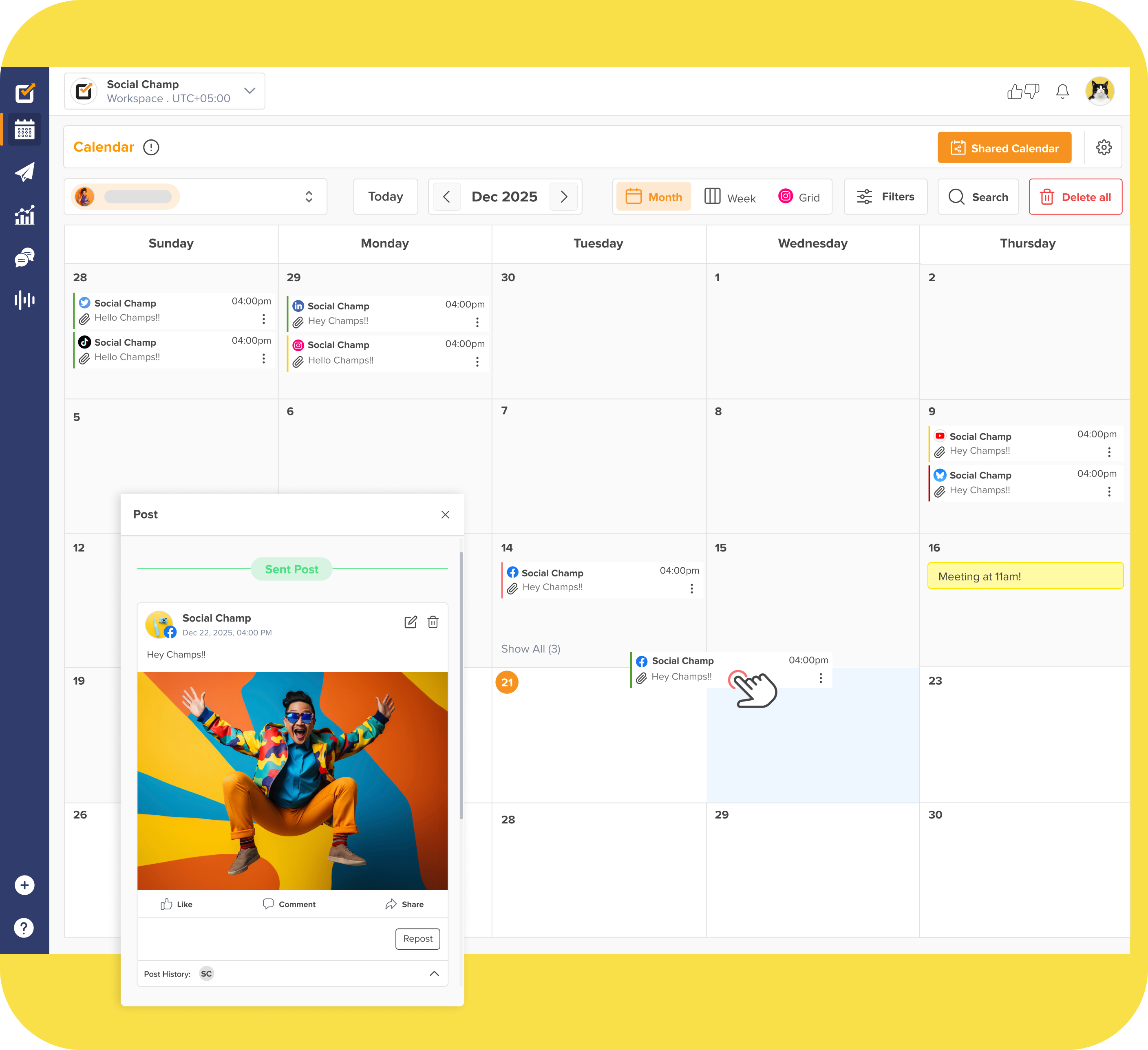
- Scheduling Pause Feature: As discussed, the first step in a crisis is stopping all automated content. A centralized tool allows you to pause or delete scheduled posts across all platforms with a single click, preventing tone-deaf marketing from sabotaging your earnest apology.
- Centralized Inbox (Engage Feature): During a crisis, DMs, comments, and replies flood in. A unified inbox gathers all these messages from every platform into one place. This prevents your team from missing critical messages and allows you to assign messages, collaborate using internal notes, and use consistent, pre-approved replies.
Basic Tools vs. Specialized Crisis Software
The level of investment you need depends on your brand’s size and risk profile.
| Component | Basic Built-in Features | Advanced Crisis Management Tools |
|---|---|---|
| Social Listening | Simple keyword tracking, direct mentions only, little sentiment data. | Real-time alerts, sophisticated sentiment analysis, and deep competitive monitoring. |
| Response Management | Individual platform inboxes; manual message assignment. | Unified Inbox, team assignment, saved/templated crisis replies, internal notes. |
| Content Control | Manual scheduling or deletion on each platform. | One-click “Pause All” scheduling across all linked profiles. |
| Use Case | Small businesses with low risk/low volume; testing keywords. | High-volume brands, complex products, high-risk industries, multiple teams. |
Stay Alert, Stay Smart, Stay Standing!
Social Champ filters the noise and surfaces the signals that matter so you react faster than anyone else.
Social Media Crisis Examples
If you’re wondering, “What is an example of a social media crisis?”, there are a ton!
Social media crisis management is not a new concept; brands have been doing it for a long time, and over the years, there have been many examples.
Let’s start with the most recent one!
Astronomer’s CEO was caught cheating on his wife with the HR at a Coldplay concert. This took the Internet by storm, and both the individuals and the company were heavily criticized.
This put the company in a very questionable light in people’s eyes, and to make it worse, a fake statement from the CEO started circulating, and the issue escalated.
As a result, the Astronomer put both individuals on leave. Later, the company posted a lighthearted video on its Instagram acknowledging the controversy in a slightly different way.
View this post on Instagram
Do you remember the OceanGate’s Titan Sub disaster? That was also one big social media crisis.
When it disappeared, OceanGate failed to update timely and it resulted in trolling; Instagram and TikTok were flooded with memes.

This caused a lot of misinformation to dominate the narrative.
Another example of a social media crisis is Volkswagen’s ad for April Fool’s that wasn’t well-received by the audience.
The ad showed a fake kidnapping teaser, and social media users were outraged by this prank.
To make it worse, VW deleted the video too late, so by then it had circulated on the Internet, and a lot of people had screenshots and even saved the video.
How to Get Ahead of a Social Media Crisis With Social Champ
When a crisis hits, you need to be fast, organized, and aware of absolutely everything happening online.
Switching between ten different apps to check comments, pause posts, and craft your response just isn’t going to cut it.
That’s where a social media management tool like Social Champ steps in!
-
Spot the Storm Before It Hits
The single most important thing during a crisis is real-time awareness.
I mean, if I don’t know people are furious, I can’t apologize, right?
Social Champ includes features like Social Listening, which is like having a thousand ears trained on the internet. I can set it up to track:
- Brand name mentions (even misspellings!).
- Key product names that might be the source of the complaint.
- Negative keywords that signal trouble (like “lawsuit,” “boycott,” or “fire your CEO!”).
You can also make the search easy by excluding certain keywords like “careers”, “hiring,” or “job openings.”
-
Hit the Emergency Pause Button
Remember how I said the first step is to stop all scheduled content?
If I’ve got a full month of posts queued up, going into every platform to manually delete them is a recipe for disaster.
With Social Champ, I can pause or delete scheduled content across all platforms from one central dashboard.
This ensures my fun, lighthearted posts aren’t accidentally going out at the same time I’m issuing a formal apology for a major error.
-
One Inbox to Rule Them All: The Engage Feature
During a crisis, you get hundreds of comments, DMs, and reviews across every channel.
It’s overwhelming! Social Champ brings all those interactions into a unified social inbox (called the Engage feature).
This is a lifesaver because:
- Nothing Gets Missed: I can see every single complaint, in one place, prioritized by urgency.
- Teamwork is Tighter: I can quickly assign a serious legal inquiry to my PR contact and a common customer question to a support rep, all within the tool. This prevents the “Who’s handling this?” confusion and stops us from accidentally replying twice.
Hear the Internet Before It Screams!
Catch every whisper about your brand before it turns into a wildfire. Don’t wait for backlash, spot it first with Social Champ.
What Aftercare and Recovery Steps Follow a Social Media Crisis?
The viral post has died down, the apology is out, and the message volume is normalizing.
Phew! But don’t coast just yet!
The days and weeks following the incident are crucial for cementing your brand’s commitment to accountability and rebuilding trust. This is the aftercare and recovery phase.
Review, Rebuild, and Re-commit
Your first priority is internal. You must move from responding to fixing and learning:
- Post-Mortem Analysis: Pull your core team together and review the whole event. What was the root cause? Was it a product, a process, or a person? How well did your crisis plan work? Where were the bottlenecks? Document every lesson learned.
- Analyze the Data: Don’t rely on gut feeling. Dive into your analytics (both platform data and monitoring tool reports). You need to know which messaging worked, which platforms stayed angry the longest, and how long it took for your sentiment to start recovering.
- Update the Playbook: Based on the post-mortem, immediately update your crisis management on social media. Add the new scenario to your list of pre-approved statements, refine your escalation path, and make sure your team contacts are current. Documenting lessons learned ensures the crisis makes you better, not just bruised.
- Communicate the Change: If your crisis was caused by a fault (a bug, a policy, etc.), follow up with your community a few weeks later. Post a sincere message saying, “You spoke, we listened. Here is the new process/product fix we implemented.” This shows your apology was genuine, not just a temporary PR bandage.
Metrics for Monitoring Recovery
You can’t declare victory until your community is demonstrably happy again. Here are the key metrics I watch to gauge a true recovery:
| Metric | Why It Matters | Target Post-Crisis |
|---|---|---|
| Sentiment Recovery | Shows that your audience is returning to a favorable or neutral view of your brand. | Return to pre-crisis positive-to-negative ratio. |
| Message Volume Return to Baseline | Confirms that the flood of crisis-related chatter has normalized. | Volume should match average daily mentions (e.g., 50 per hour, not 500). |
| Engagement Rates | High engagement on your positive, non-crisis content signals that trust is returning. | Should return to normal levels on your proactive marketing posts. |
| Follower Churn | Monitoring the number of people unfollowing you. | Minimize the outflow; a return to normal growth/loss rates. |
Featured Article: X / Twitter Management Tools
Conclusion
Look, no brand is perfect. We all mess up.
The difference between a brand that collapses under pressure and one that comes out stronger isn’t about avoiding the crisis; it’s about how you handle it.
A social media crisis is undoubtedly stressful.
But if you treat it as an intense learning experience and prioritize honesty and empathy, you’ll not only weather the storm but also forge a more resilient relationship with your community.
You got this!