You know that feeling when you’re scrolling through your feed, and you see a post with 50,000 likes, and you think they’re just lucky.
Well, they are, but that’s not all!
After looking at the data, I’ve realized that virality is actually a repeatable science.
Short Summary
- Forensic marketing is the process of performing an autopsy on successful content to identify the specific variables, like timing, structure, and audience, that caused it to explode.
- Unlike general marketing, which relies on gut feelings and future planning, the forensic approach uses backwards-looking data to find verifiable evidence of what actually works.
- A successful clone requires three layers: a high-impact hook to stop the scroll, an emotional trigger to provoke a reaction, and a shareability factor that makes the user look good for sending it.
- You can reverse-engineer success by extracting the skeleton (the structural framework) of a post and applying your own niche expertise to it.
- Testing multiple variations of hooks and using tools like Social Champ allows you to automate distribution and analyze the best times to post based on proven data.
In fact, 93% of marketers see video content as an important part of their marketing strategy. Because people aren’t just consuming more; they’re sharing more, too.
Honestly, if you aren’t reverse-engineering these unicorn posts, you’re leaving your growth to chance.
Let’s break down how I look at these viral moments and how we can clone that DNA for our own brands.

In this guide, I’m going to show you:
- How to find the exact spark that started a viral fire.
- A breakdown of the Hook, the Trigger, and the Shareability Factor.
- My step-by-step process for stripping a post to its skeleton and rebuilding it for your niche.
- How to use variations and timing to make sure your version actually hits.
What Is Forensic Marketing?
I know the word forensic usually makes people think of lab coats and crime scenes, but in our world, it’s just a fancy way of saying we’re doing a marketing autopsy.
While general marketing is often about looking forward, setting goals, picking colors, and hoping for the best, forensic marketing is about looking backwards. It’s the process of taking a successful campaign (or a failed one!) and tearing it apart to see exactly what made it tick. I like to think of it as the “Why” behind the “What.”
To give you a better idea of how it shifts your mindset, I’ve put together this quick comparison:
Forensic vs. General Marketing
| Feature | General Marketing | Forensic Marketing |
|---|---|---|
| Primary Focus | Creating new content & brand awareness | Investigating why specific content worked |
| Data Source | General trends & gut feelings | Real-world evidence & post-mortems |
| Goal | Reach a broad audience | Replicate specific success triggers |
| Method | Planning and Execution | Deconstruction and Reconstruction |
| Success Metric | Likes, Follows, Impressions | Proven ROI and Repeatable Formulae |
When I switched to a forensic mindset, I stopped asking, “What should I post today?” and started asking, “What structure is currently winning, and how can I adapt it?” It’s a game-changer for your productivity because you’re no longer staring at a blank page.
Below are the steps to execute forensic marketing for your brand!
Manual Posting Tax is Costing You Content!
Find the Source of the Success
When I see a post blowing up, the first thing I do is think about the people who’re sharing that post. Usually, it’s not just everyone; it’s a specific subculture.
I’ve noticed that posts often go viral because they hit a very specific community (like “Data Science Twitter” or “Gardening TikTok”) before leaking out to the masses. If you can identify that initial spark, you can target those same people with your version.
-
Analyzing the Target Audience
I like to look at the comments. Are people tagging their friends with or are they arguing? If they’re tagging friends, the post tapped into identity. If they’re arguing, it tapped into controversy. Knowing which one it is tells you exactly what vibe you need to replicate.
-
Platform-Specific Factors
I’ve learned the hard way that you can’t just copy a LinkedIn post and put it on TikTok. The algorithms are looking for different things. On TikTok, it’s all about watch time and re-watches. On LinkedIn, the algorithm currently loves dwell time (how long you stay reading that long-form post) and meaningful comments.
Pro Tip
Don’t just look at the Likes. Look at the saves. High saves tell the algorithm that your content is valuable or educational, which often triggers a much wider reach than a funny meme that only gets quick likes.
The Three Parts of a Viral Post
When I’m dissecting a post, I always see the same three-layer structure.
-
The Hook (First Impression)
You have about 1.5 to 3 seconds before I (and everyone else) scroll past you. The best hooks I’ve seen usually involve a pattern interrupt. It’s a bold statement like, “Stop doing X if you want Y,” or a visual that looks slightly off to grab attention.
-
The Emotional Trigger
I’ve found that meh content never goes viral. You need high-arousal emotions. Think: awe, anger, or amusement. If I’m not feeling a physical reaction to your post, I’m probably not going to share it. The more shares you get, the better it is for your reach.
-
The Shareability Factor
This is the social currency aspect. When I share your post, what does it say about me? Does it make me look smart? Helpful? Funny? If your post makes the sharer look good, you’ve won.
Featured Article: The eCommerce Content Strategy That Eliminates Buyer’s Doubt
How to Reverse-Engineer the Content
This is where I get into the lab and start building. I’m not looking to plagiarize; that’s a one-way ticket to getting canceled or just ignored. I’m looking for ways to create similar content that has the same vibe but feels like me.
Extracting the Framework
In forensic marketing, you literally write out the structure of the viral post.
- Line 1: Bold Claim. * Line 2: The ‘Why’ (The Problem). * Line 3: The ‘How’ (The Solution). * Final Line: Call to Action.
Once you have that skeleton, you just put new skin on it by applying my own expertise.
Swapping the Topic to Your Niche
If I see a viral video about “3 Morning Habits of Millionaires,” and I’m in the pet industry, I’ll clone that into “3 Morning Habits of Calm Dog Owners.” You’re using a proven engagement formula but providing totally original, high-value content.
Featured Article: How to Create a UGC Video That Converts?
Testing Your New Version
I’ll be the first to tell you: your first clone might not hit 100k views. And that’s okay. This is a game of iterations, and you’ll face failures even when using forensic marketing.
-
Create Multiple Variations
I never just post one version. I’ll take that “3 Morning Habits” idea and film three different hooks. One might be a direct question, another a mistake warning, and the third a secret reveal.
-
Timing and Distribution
Timing is still huge. I try to post my clone during the same window the original took off. This is an area where Social Champ is a lifesaver; you can analyze your previous best-performing times and automate the posting so you aren’t glued to your phone at 6 AM on a Saturday.
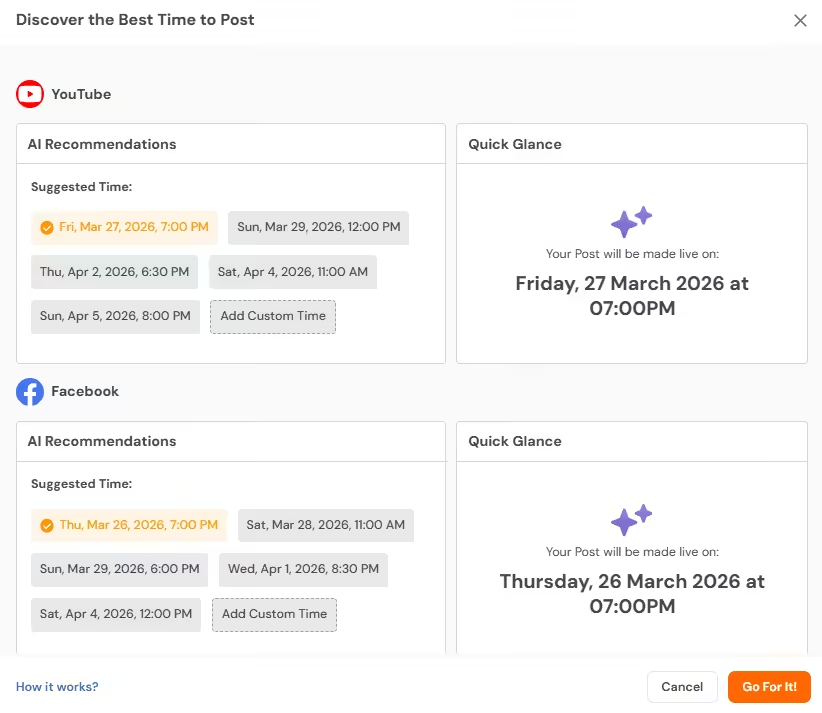
Social Champ’s Best Time to Post Feature
Your Best Content is Dying in Silence!
Executing Your Clone
Once you’ve got your skeleton and your new skin ready to go, the actual execution is where most people get cold feet. I’ve been there; you worry that people will see through it. But don’t worry, it won’t happen if you do the following!
-
Avoid the Uncanny Valley of Content
When you’re cloning a post, make sure it doesn’t feel stiff or robotic. I always try to add one unique mutation, a personal story, a controversial take, or a specific data point that only I have. This ensures the post feels like me, even if the structure is borrowed from a viral hit.
-
Managing the Surge
If your forensic approach works (and it usually does), you’re going to get a spike in engagement. This is the moment where I see most creators drop the ball. You need to be ready to engage with the commenters in real-time to keep the momentum going.
Pro Tip
This is exactly where Social Champ becomes even more helpful. When that post starts taking off, you can use their social inbox to manage all the incoming chaos from one screen. Instead of getting overwhelmed by notifications across three different apps, you can stay focused on fueling the fire.
Conclusion
In my opinion, the biggest mistake we make is thinking viral success is a one-off event. It’s not. It’s a skill. The more you practice looking at content through a forensic marketing lens, the better you get at spotting the DNA of a winner before you even start creating.
Stop guessing and start dissecting. Your next unicorn post is probably already sitting in your feed; you just need to take it apart to see how it works.