Ever feel like your marketing is doing the most, but your audience is just… not impressed? That’s usually what happens when your messaging isn’t actually speaking to the right people.
The truth is, even your most perfectly crafted campaign can fall flat if you don’t really understand who you’re talking to. So, if you’re still treating your audience like one big blob of “everyone,” don’t be surprised if they keep scrolling right past you without a second thought.
Short Summary
- Buyer personas help you understand your ideal customers and create more targeted marketing.
- Different persona types, such as decision-makers, researchers, and price-conscious buyers, shape how messaging should be delivered.
- A structured, step-by-step process ensures personas are built using real data, not assumptions.
- Social Champ helps bring persona-driven strategies to life through organized, consistent content planning.
- Avoiding common mistakes like guesswork and vague profiles ensures your personas stay accurate and useful.
McKinsey research shows that 71% of consumers expect personalized interactions from brands. Anything less feels like background noise they can easily scroll past.
Buyer personas help you stop guessing and start to understand who you’re talking to. When you know who your audience is, everything from your tone to your timing with a social media scheduler suddenly starts making sense.
This guide is all about what buyer personas are, why they matter, and how you can create them without overcomplicating your marketing strategy.
What Are Buyer Personas?
Buyer personas are semi-fictional profiles that represent your ideal customers based on real data, behavior patterns, and research. They help you understand who you are really talking to, so your messaging actually lands instead of floating around in the void.
Their main role is simple but powerful. They align your product messaging with real customer needs, pain points, and motivations so you stop guessing and start connecting.
To avoid confusion in your marketing strategy, it helps to clearly understand how an audience, a customer, and a buyer persona differ in practice.
- An audience is broad and general
- A customer is someone who has already bought from you
- A buyer persona is a detailed profile of the person you are trying to reach or convert
So no, they are not the same thing, and treating them like they are is where most marketing struggles.
Buyer personas play a key role across different teams in a marketing strategy, and their impact can be seen in several practical ways.
- Sales teams use them to understand objections and tailor pitches
- Content teams use them to create posts, blogs, and emails that feel relevant
- Campaign teams use them to improve targeting and increase conversions
Those are just some of the ways companies use buyer personas. Without them, your campaigns may struggle to connect with the right people, and your efforts may not fully align with customer needs and expectations.
Build Persona Driven Content Strategy
Types of Buyer Personas Every Brand Should Know
Buyer personas are not one-size-fits-all, and assuming they are is where a lot of marketing strategies quietly go off track. Different goals, behaviors, and buying motivations mean different marketing persona types show up depending on your brand.
Let’s take a look at the different types of buyer personas you are likely to encounter when building a well-targeted marketing strategy:
- Decision-makers: These are the people who approve purchases and care about outcomes, ROI, and big-picture value
- Researchers: These personas dig into details, compare options, and want proof before they even think about buying
- Price-conscious buyers: These ones are always scanning for the best deal and will question every shilling or dollar
- Loyalty-focused customers: They stick with brands they trust and value consistency, rewards, and long-term relationships
- Impulsive buyers: They act fast, respond to emotion-driven messaging, and often buy with minimal hesitation
While these persona types appear across many industries, their behavior and decision-making style can shift quite a bit depending on whether you are operating in B2B or B2C environments.
In B2B settings, decisions often involve multiple stakeholders, longer evaluation cycles, and a stronger focus on logic, ROI, and risk reduction.
Buyers tend to rely heavily on research, comparisons, and detailed information before making a move. As such, your B2B marketing strategy should prioritize clear value and data-driven messaging.
In B2C environments, decisions are usually faster and more emotionally driven, with personal preferences, lifestyle, and convenience playing a much bigger role. Messaging here often needs to be simpler, more engaging, and more immediately appealing.
The same persona type can behave very differently depending on the context, which is why understanding your industry is just as important as understanding your target audience.
Featured Article: The Ultimate Guide to Social Media Campaign Planning
How to Create Effective Buyer Personas (Step-by-Step Guide)
If you are still guessing who your audience is, your consumer marketing strategy is basically running on prayers and hope. Spoiler alert: these don’t convert.
The good news is that you can fix that with a clear, structured process that actually makes sense. Here are the actionable steps you need to follow to build buyer personas that are grounded in real data, not wishful thinking:
-
Define Goals
Start by deciding what you actually want your buyer personas to help you achieve. This could include improving targeting, increasing conversions, or refining your messaging.
Be specific about success before you start collecting data. Ask yourself questions like: What problem are we solving, and who are we solving it for?
-
Conduct Research
This is where you stop guessing and start gathering real information from analytics, CRM data, and market insights. You are looking for patterns in behavior, preferences, and decision-making.
Ask questions such as: What pages do users visit most, and where do they drop off? What content drives the most engagement?
-
Segment by Behavior/Demographics
Group your audience based on shared traits like age, job role, buying behavior, or interests. This helps you spot meaningful patterns instead of treating everyone the same.
Ask yourself: Who buys quickly, who takes time, and who needs more convincing?
-
Interview Real Customers
Talk to your actual customers instead of assuming you already know them. Their answers will often surprise you in the best way.
Ask questions like: Why did you choose us, what almost stopped you from buying, and what problem were you trying to solve?
-
Build Detailed Profiles
Now turn your findings into clear, structured personas with names, goals, pain points, and motivations. This is where the data starts looking like real people.
Make sure each profile reflects real evidence, not creative fiction. Include behavioral insights backed by your research.
-
Validate and Iterate
Test your personas against real campaigns and see if they actually improve performance. If they do not, adjust them based on new data.
Keep asking: Are these personas still accurate, or has customer behavior shifted? Because yes, your audience changes whether you keep up or not.
At the end of the day, strong buyer personas are not built on assumptions or guesswork. They are shaped by real data, real customer behavior, and real conversations that reveal what your audience actually wants.
When your personas are data-backed, your marketing stops being random and starts becoming intentional. And that is where better targeting, stronger messaging, and higher conversions quietly do their thing.
Buyer Persona Examples for Inspiration
If you are still staring at a blank persona template like it personally offended you, don’t worry. Let’s break down a couple of common personas you will likely recognize in real life:
- “Marketing Mary” (B2B): A mid-level marketing manager juggling deadlines, KPIs, and stakeholders who all have opinions. She cares about efficiency, ROI, and tools that make her life easier, not harder.
- “Budget Ben” (DTC eCommerce): A price-sensitive online shopper who loves a good deal and compares everything before clicking “buy now.” He is motivated by discounts, value, and fast shipping.
- “Founder Felix” (Startup/B2B SaaS): A time-starved decision-maker looking for scalable solutions that save effort and support growth. He wants clarity, speed, and zero fluff.
Now let’s zoom in and actually visualize one of them:
Persona Snapshot: Marketing Mary
- Background: Marketing manager at a growing SaaS company
- Goals: Improve campaign performance and prove ROI to leadership
- Challenges: Limited time, scattered tools, and constant reporting pressure
- Pain points: Inefficient workflows and unclear attribution data
- Quote: “I just need tools that actually save me time, not create more work.”
- Behavior: Research-heavy, relies on demos, case studies, and peer recommendations
And there you have it. Clear, structured personas that feel less like theory and more like real people you can actually market to.
Featured Article: How Often to Post on Social Media for Consistency
Social Champ Use Case: How Personas Power Better Content Scheduling
Posting “whenever you remember” is not a strategy; it is a cry for help. If your content calendar feels like a chaotic guessing game, investing in a social media management tool is a smart move.
Social Champ is a powerful tool that turns scattered posting habits into a structured, intentional content system. Here’s how it can help you turn strategy into execution that actually aligns with your audience’s needs and behavior:
Content Relevance That Actually Hits
Buyer personas help you create content that speaks directly to specific needs, pain points, and motivations. Instead of posting generic tips and hoping for engagement, you start tailoring messages for “Marketing Mary,” “Budget Ben,” or whoever your audience really is.
Now imagine mapping all of that into a clear, structured calendar where each post has a purpose and a specific marketing persona behind it. With Social Champ’s calendar, you can organize content in advance so every week reflects a balanced mix of messages tailored to different audience segments.
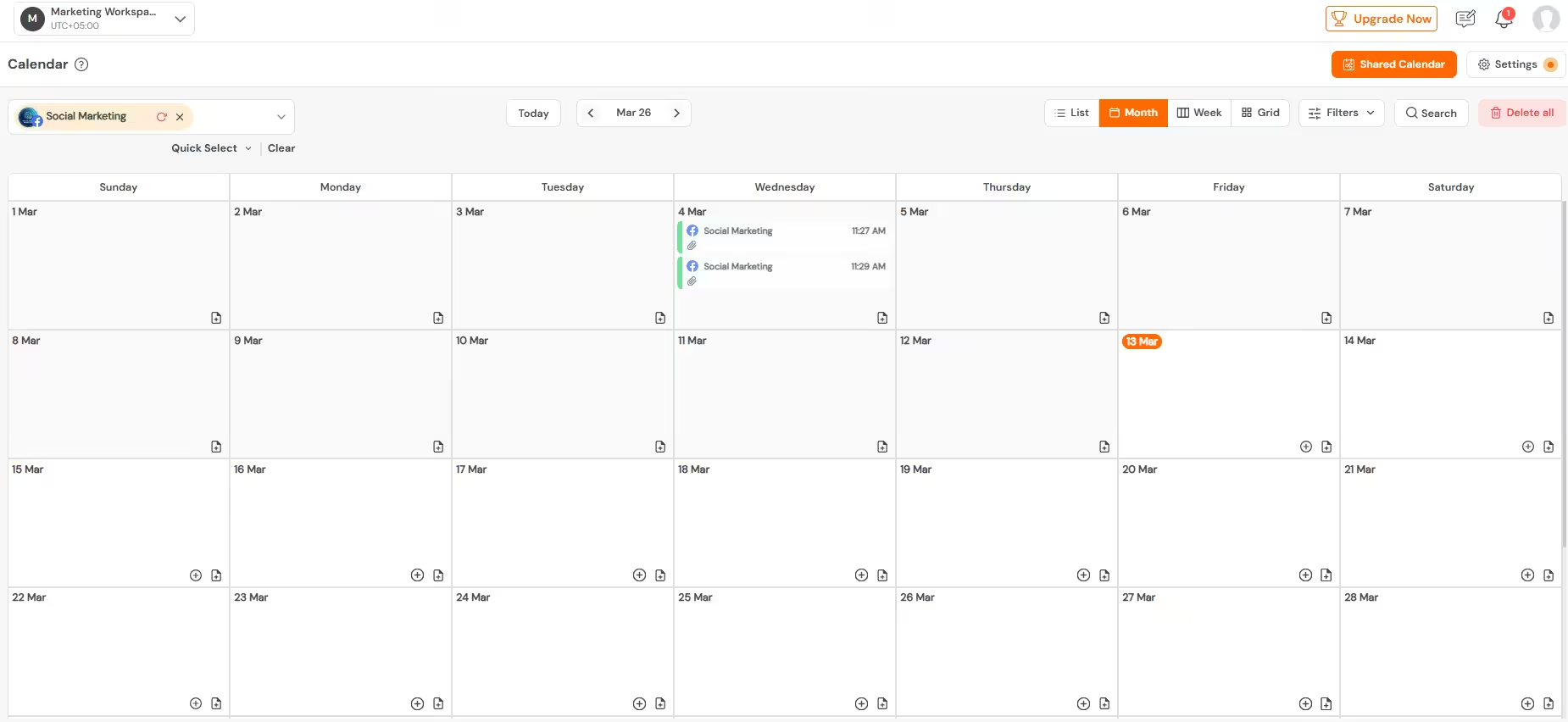
Social Champ’s calendar allows you to plan content days, weeks, or months in advance, which gives your persona-driven strategy the consistency it needs to actually work.
It helps you map out content for different personas without neglecting any of them. You can intentionally rotate between educational, promotional, and trust-building content based on what each audience persona needs.
Plus, long-term planning makes it easier to align content with campaigns, product launches, or seasonal trends that matter to specific personas
Smarter Timing That Respects Behavior
Different personas do not scroll at the same time, and pretending they do is where many content marketing strategies go wrong. Early-career professionals might engage during lunch breaks, while decision-makers are more active early morning or late evening.
With Social Champ, you can align posting times with when each audience persona is most active, thanks to its AI Suggested Time feature.
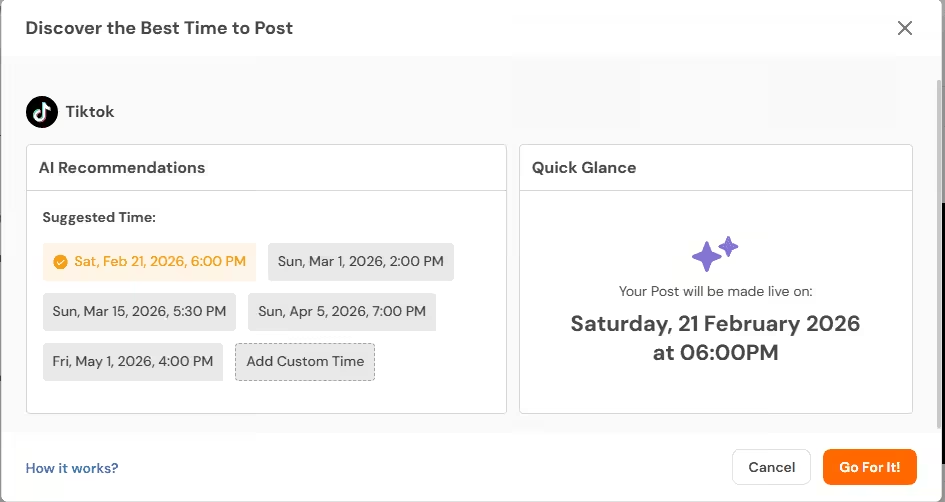
With this feature, you’ll always know the best times to post on social media. That means your content shows up when your target audience is actually paying attention, not when your intern remembers to hit publish.
Platform Targeting That Stops Wasting Effort
Not every persona lives on the same platform, and yes, forcing LinkedIn content onto Instagram is still a thing people do. Buyer personas help you match the right message to the right channel.
Social Champ makes this easier by letting you plan, schedule, and customize posts for each platform in one place. Its dashboard is tailored to how different platforms actually work:
Take a look at Social Champ’s dashboard for Instagram:
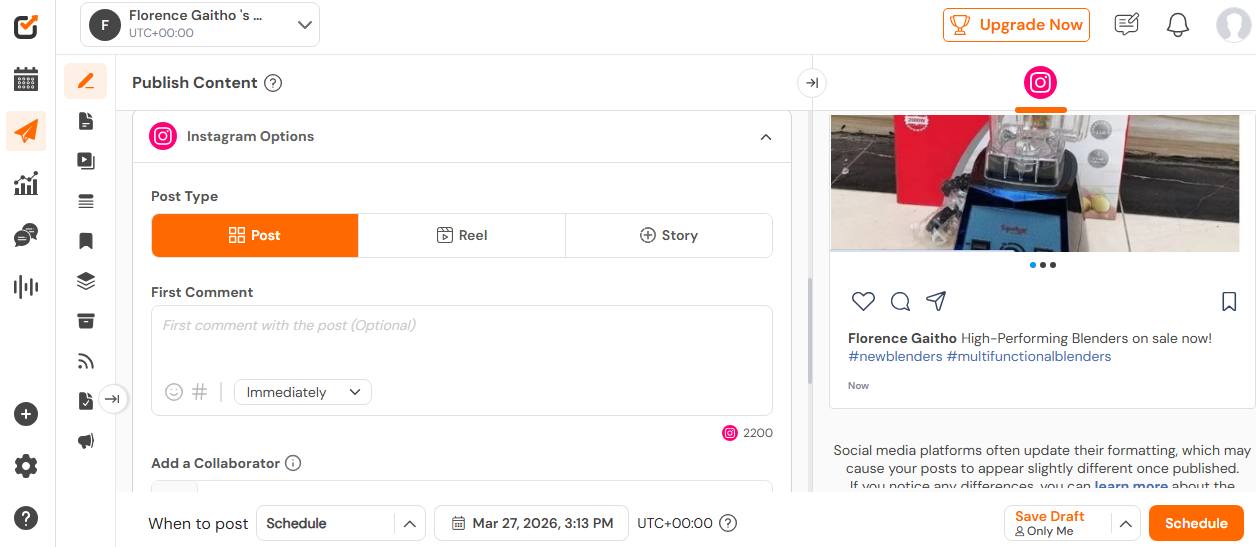
When it comes to Instagram, Social Champ offers platform-specific features that you simply will not find across other social channels, including:
- Post scheduling support
- Reels scheduling support
- Story scheduling with reminders or direct publishing
- Add a collaborator
- First comment scheduling
- Link your post
These features make it clear that Instagram is not just another platform in your lineup, and Social Champ treats it that way.
Now take a look at how Social Champ’s dashboard for YouTube differs from Instagram’s.
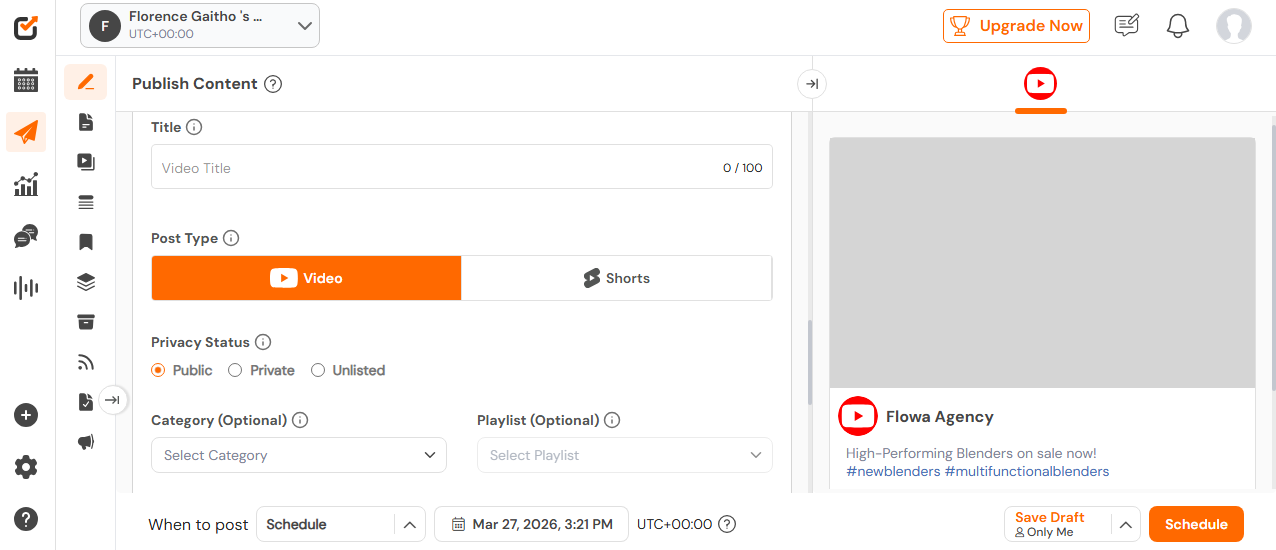
Social Champ’s dashboard for YouTube offers platform-specific options such as:
- Video title and description optimization: You can craft detailed titles and long-form descriptions that align with YouTube’s search-driven nature
- Privacy and visibility controls: Choose whether your video is public, private, or unlisted before it goes live
- Playlist selection: Add videos to specific playlists to improve organization and discoverability
- Audience settings: Specify whether the content is made for kids, which is a requirement unique to YouTube
- Tag and keyword management: Include relevant tags to improve search visibility within YouTube’s algorithm
These options reflect how YouTube prioritizes search, discoverability, and long-form video content, which is very different from how other platforms operate.
Social Champ simply gives you the structure to keep that strategy consistent without the chaos of last-minute posting or guesswork.
The result is content that feels intentional, reaches the right people, and actually supports your marketing goals instead of just filling a feed.
Simplify Multi-Persona Content Planning
How Buyer Personas Improve Your Marketing Strategy
Buyer personas are not just a nice-to-have detail; they quietly shape almost every part of your marketing strategy. When you know exactly who you are talking to, your decisions stop being random and start being intentional.
Here is how they upgrade different areas of your marketing:
- Content strategy: You create content that actually speaks to real needs instead of guessing what might work
- SEO: You target search intent more accurately, which brings in traffic that is actually interested in what you offer
- Paid ads: You refine audience targeting and messaging, so your budget stops disappearing into the void
- Product development: You build features and solutions based on what real users actually want, not assumptions
And the impact shows up fast in performance:
- Higher email open rates because subject lines finally feel relevant
- Better CTA targeting that actually gets clicks instead of being ignored
- Lower customer acquisition cost because you are reaching the right people from the start
In short, personas shift your content marketing strategy from guesswork to a clear understanding of why your strategy works and who it is working for.
Featured Article: 15 Social Media Engagement Strategies to Increase Customer Loyalty
Common Mistakes to Avoid When Creating Buyer Personas
Even the best marketing teams can get a little carried away when building buyer personas, and that is where things start to go off track.
Here are some common mistakes you definitely want to avoid if you are serious about getting this right:
-
Relying on Assumptions Instead of Data
Guessing who your customers are might feel faster, but it usually leads to personas that do not reflect reality. Without real insights from analytics, surveys, or customer feedback, you are basically writing fiction and calling it strategy.
-
Making Personas Too Broad
If your persona could apply to almost anyone, it is not useful. Vague descriptions make it impossible to create targeted messaging that actually connects with specific audience needs.
-
Ignoring Real Customer Feedback
Skipping interviews or surveys means missing out on the most valuable insights. Your customers will tell you exactly what they want if you actually ask them the right questions.
-
Creating Too Many Personas
More is not always better. Too many personas can overwhelm your strategy and make it harder for your team to stay focused on what actually matters.
-
Treating Personas as a One-Time Task
Audiences evolve, behaviors change, and markets shift. If your personas stay frozen in time, your marketing will quickly fall out of sync with reality.
The bottom line is simple: sloppy personas lead to sloppy marketing, and your target market can tell when you are not paying attention.
Featured Article: Our Team Tested 70+ Productivity Tools in 2026 – Here Are Our Top 15 Picks
Conclusion
Buyer personas are what separate scattered marketing from a strategy that actually understands its audience. When they are built using real data and applied consistently, every message, campaign, and decision becomes more focused and effective.
And when it comes to putting that strategy into action, Social Champ makes it easier to keep everything aligned. From planning persona-driven content to managing multiple platforms in one place, it helps you stay consistent without losing sight of who you are speaking to.