For social media architects, the choice between X and Bluesky comes down to reach vs. ownership. While the industry has fragmented, Social Champ’s data shows that X remains the primary engine for visibility, even as Bluesky scales its decentralized infrastructure (the AT Protocol).
But the Bluesky vs. Twitter debate does not end there. Our data highlights a clear dominance by X, but a growing, high-intent migration toward Bluesky.
| Platform | Market Share (%) | Key Technical Driver |
|---|---|---|
| X (Twitter) | 69% | Proprietary algorithmic amplification |
| Bluesky | 14.3% | Decentralized AT Protocol and custom feeds |
| Threads | 8.4% | Instagram graph integration |
| Mastodon | 8.3% | ActivityPub federation |
Essentially, the challenge for modern teams is managing the technical debt of multi-platform distribution. You cannot afford to ignore 69% of the market on X, but you cannot risk 100% platform dependency.
TL;DR
- X maintains the lion’s share of microblogging volume at 69%, which makes it the essential choice for viral reach and global news.
- Bluesky has captured 14.3% of the market, winning over high-intent communities and power users through its decentralized AT Protocol.
- X relies on a proprietary AI algorithm to drive discovery, while Bluesky offers Algorithmic Choice, ultimately allowing users to select their own feeds.
- X utilizes a paid model (X Premium), whereas Bluesky uses Domain-based Verification. This allows brands to use their own website URL as their handle for maximum trust.
- With X, you get an established ad ecosystem for rapid scaling; Bluesky remains an organic-first frontier, prioritizing community-driven growth without native ad interruptions.
- There is no need to choose between reach and community. By using Social Champ, you can eliminate the “switching cost” and manage both platforms through a single, unified dashboard.
So, if you’re determining where to allocate your ad spend and content resources, I’ve compiled this guide for you. Here’s what we’ll cover:
Short Summary
- Don’t choose sides; X provides the “Global Stage” for viral reach, while Bluesky offers a “High-Fidelity Workshop” for deep, niche community trust.
- It’s best to optimize Bluesky and X content for Social SEO. You can do this by using “answer-first” structures and keyword-rich posts.
- To measure success on both platforms, shift your focus from follower counts to share of intent.
- You can use Social Champ for cross-posting on both Bluesky and X.
Bluesky vs. Twitter (X): How the Two Platforms Actually Work
For most users, X and Bluesky look similar; you post a thought, people heart it, and the conversation moves on. But for those of us managing brands, the “engine” under the hood changes everything. In 2026, the biggest difference isn’t the features; it’s who owns your data.
-
The Algorithm (Who Sees Your Content?)
On X, you are playing a game with a “Black Box.” The platform uses a secret, central algorithm to decide what goes viral. It usually favors “high-velocity” content, which includes things that get a lot of clicks quickly. It’s great for reaching 69% of the market, but you have very little control over who sees you.
On Bluesky, the power shifts back to the user. Instead of one algorithm, Bluesky offers Custom Feeds. Users can choose to follow feeds specifically for “Tech News,” “Digital Marketing,” or even just “Posts from Mutuals.”
Considering this, if you’re trying to go viral, X would be your platform. But if you want to be relevant to specific communities, build your presence on Bluesky.
-
The Verification (Proving You Are “You”)
We’ve all seen the confusion with verification lately.
- On X, the verification is tied to a monthly check. If you pay, you get the blue checkmark. It’s simple, but it doesn’t always prove a brand’s official status.
- On Bluesky, they use your domain name. For instance, your handle would be @veganbakery.com instead of just a username. Because you have to own the website to use the handle, it provides a “gold standard” of trust that non-native speakers and global audiences can verify instantly.
Why Not Both?
Reach a 100% of your audience by managing Bluesky and X from a single dashboard! -
The Safety and Moderation
No brand wants its ad appearing next to “rage-bait” content. That’s why:
- X uses Community Notes. It’s a crowd-sourced way to fact-check posts. It’s helpful, but it happens after a post has already gone viral.
- Bluesky uses a tool called Ozone. It allows users and organizations to create their own “moderation labels.” You can subscribe to a specific filter that blocks spam or offensive content based on your own brand’s standards.
-
Ownership (Can You Take Your Followers With You?)
This is the most “expert” part of the conversation.
- X is a “walled garden.” If the platform changes or goes away, you lose your followers and your history.
- Bluesky is built on the AT Protocol. Think of it like a phone number; you can switch from one carrier to another and keep your number. Bluesky allows you to move your entire account (followers and all) to a different app if you ever decide to leave.
The “Smart Move” With Social Champ
Managing two totally different systems can feel like a full-time job. This is where Social Champ saves the day. Instead of learning two sets of rules, you can use one dashboard.
You can post your “Broadcasting” content to X to hit that 69% market share, and simultaneously send your “Community” content to your verified Bluesky handle. You get the reach of the old world and the safety of the new one, all in one click. Try it now for free!
Featured Article:How to Schedule Tweets for Free
What to Post on X vs. Bluesky
Now that we’ve looked at the engines, let’s talk about the fuel. Even though both platforms are about short-form text, the “unwritten rules” of engagement are miles apart.
If you want to convert the audience, you need to tailor your message to the room you’re standing in.
What Works on X
In 2026, X has moved away from simple “likes” and toward behavioral data. The algorithm doesn’t just care if someone clicked a button; it tracks “dwell time” (how long someone paused to read) and “response velocity” (how fast the conversation is moving).
With 69% of the microblogging market, X is your primary engine for brand awareness. If you have a major product launch or a piece of breaking news, this is where you go to get it in front of thousands of eyes in seconds.
Here’s what’s working on X:
- Experts are using Threads as whitepapers. Instead of a 10-page PDF, you write a 10-post thread. Because X’s engine prioritizes content that keeps users on the app, well-structured threads often get 5x the reach of a single post with a link.
- You want your post to hit a “behavioral cluster”, which is a group of users with similar interests, so that the algorithm pushes you into the “For You” feeds of millions.
- X uses Contextual AI to read your text and images. One or two hashtags are enough to “seed” the topic; anything more makes you look like a bot and actually hurts your “dwell time” as users scroll past the clutter.
What Works on Bluesky
If X is a stadium, Bluesky is an invite-only workshop. It’s built on the AT Protocol, which means there is no “secret algorithm” deciding what you see.
While its 14.3% market share may seem small, you have to know that these are “High-Fidelity” users, which means your audience is people who have intentionally left the noise of X to find real substance.
The platform is personal. On Bluesky, your followers actually see what you post (imagine that!). There is no “algorithmic suppression” to force you into buying ads. This makes every follower 3–5x more valuable than an X follower because their engagement is rooted in choice, not a forced feed.
Here’s what’s working on Bluesky:
- Custom Feeds work best for Bluesky. Experts aren’t just posting to their followers; they are targeting Custom Feeds. If you’re a SaaS brand, you want your posts to show up in the “SaaS Founders” or “Open Source” feeds.
- You aren’t chasing a million views; you’re chasing a dozen high-value replies. In the decentralized world, a reply from an industry leader is worth more than a thousand “likes” from a bot farm.
- Use your Domain as your Handle (e.g., @yourbrand.com). It’s the ultimate trust signal. In a world of AI-generated spam, showing the community that your account is officially tied to your web domain builds instant credibility with a global, non-native audience.
How Do X and Bluesky Posting Specs Affect Your Strategy?
Knowing what to post is only half the battle. The real challenge for social media leads is the execution: how do you take a high-level strategy (like “building community fidelity”) and squeeze it into a 300-character technical limit?
There is often a disconnect here. You might have a brilliant industry insight, but if you ignore the platform’s physical constraints, the algorithm will bury it. Conversely, if you focus only on the “specs,” your content will feel like bot-generated filler.
To turn your strategy into actual clicks, you have to treat the technical specs below not just as “rules,” but as a framework for your creativity. For example:
- On X: Use the high character limit for Premium accounts to turn a standard post into a “Mini-Blog,” but keep your “Dwell Time” hook in the first 280 characters to catch the scroll.
- On Bluesky: Use the 300-character limit to force brevity. Since there is no “See More” button for long text, your entire value proposition must be visible at a glance to spark that high-value reply.
Here is the technical breakdown you need to keep on your desk while drafting your next campaign
Quick Comparison: Bluesky vs. Twitter Posting Specs
| Feature | X (Twitter) | Bluesky |
|---|---|---|
| Character Limit | 280 (Free) / 25k (Premium) | 300 Characters |
| Video Support | Up to 3 hours (Premium) | Up to 3 minutes |
| Images | Up to 4 | Up to 4 (Alt-text is highly encouraged!) |
| Best Frequency | 3–5 times per day | 1–2 high-quality interactions |
How to Repurpose the Same Post for X and Bluesky
To make this work, we have to stop treating these platforms like two different tabs and start treating them like two different rooms.
Imagine you’re the lead for a B2B logistics brand. Let’s call it CloudFlow. You’ve just built a killer new sustainability tracker. If you just copy-paste a link to both platforms, you’re going to fail. Here is how you actually play it:
Step 1: Use X as Your Global Stage
In the “stadium” of X, you need to be loud and fast. Since the algorithm is hunting for dwell time, don’t just say, “We have a new feature.” No one cares.
Instead, build on it with threads to craft a “Value-Stack.”
Start with a post that hits a nerve: “Your supply chain is leaking money because you aren’t tracking carbon.”
Use the next 5 posts as your “mini-whitepaper.” Break down the data. (P.S. You can use the Champ AI Suite to sharpen your technical language so it sounds authoritative but remains easy for your global partners to digest!)
This way, you’re giving the algorithm exactly what it wants: a reason for people to stay on the page and read.
Step 2: Use Bluesky as Your Technical Workshop
Now, take that same feature over to the “coffee shop” of Bluesky. If you bring that “stadium energy” here, people will ignore you.
On Bluesky, you’re looking for trust. Here’s what you can do:
Post a raw screenshot of the dashboard. Instead of a sales pitch, ask a real question: “We’re finally launching our carbon tracker, but the legacy API integration was a nightmare. To the other devs in #LogisticsTech: how are you handling 10-year-old data silos?”
Because you’re using your domain as your handle (@cloudflow.com), people know you’re the official source. They’ll actually reply because you’re acting like a peer, not a billboard.
How to Manage X and Bluesky From One Dashboard
For most industry leads, the problem isn’t a lack of ideas; it’s a lack of time. In 2026, the cost of “manual switching” (logging out of X, logging into Bluesky, re-formatting the same image, and re-writing the same hook) is a silent ROI killer.
There is a massive gap between having a presence and having a strategy. If you are manually posting, you are likely sacrificing one platform for the other. This is where the “Social Engine” model takes over.
The “Social Engine” model basically means using a hybrid approach to automate the things that require consistency (like a posting schedule), so you have the free time to do the things that require a human touch (like replying to a lead on Bluesky).
Bridging the Gap With Social Champ
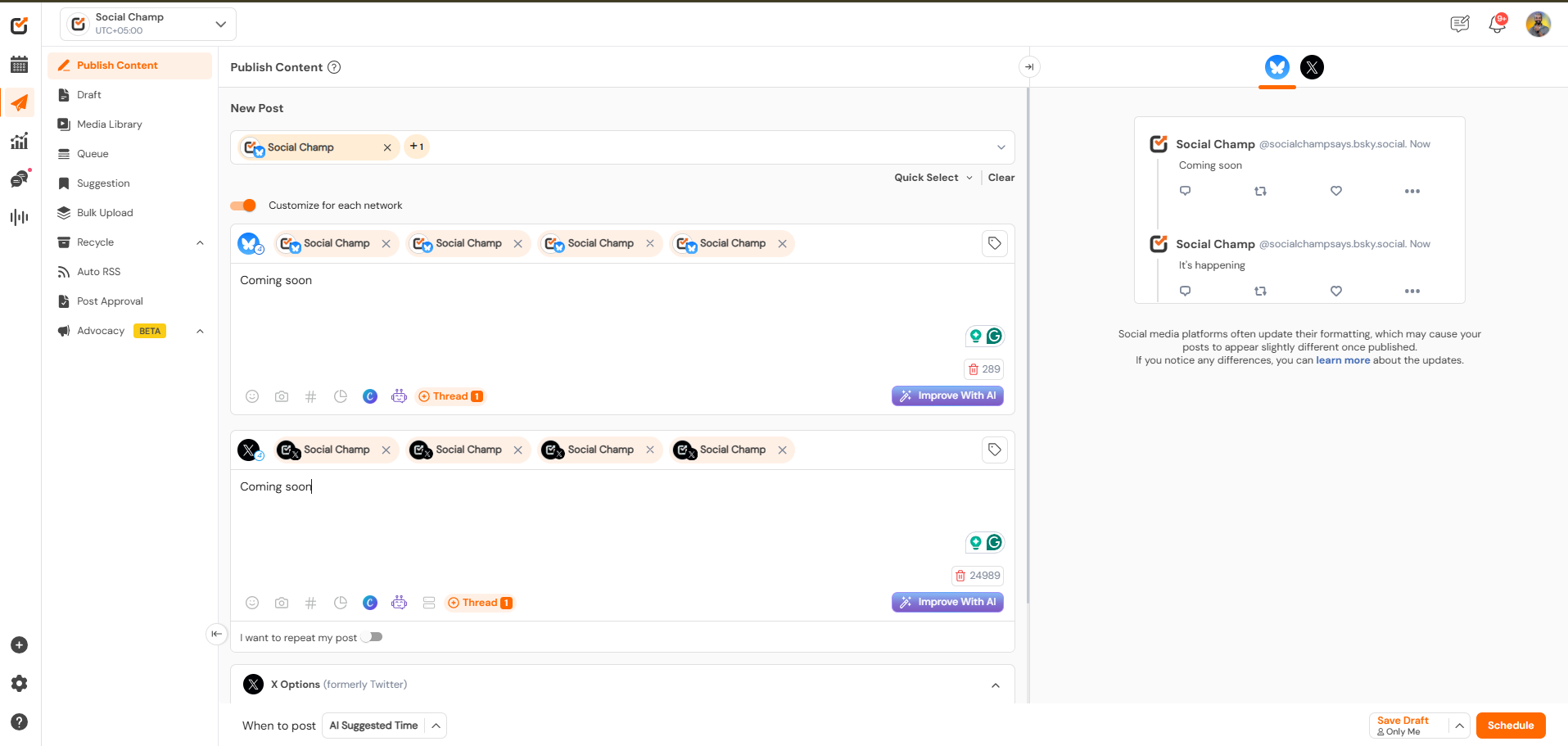
To dominate 83.3% of the microblogging market (the combined power of X and Bluesky), you need a tool that speaks both “Centralized” and “Decentralized” fluently.
Social Champ is built to handle this exact friction. With this tool, you can:
- Draft your core insight once with the multi-platform composer. Use the platform-specific tabs to tailor your character counts and style for X, Bluesky, Mastodon, and Threads, among other social platforms, simultaneously.
- Have a month’s worth of industry insights? You can upload up to 300 posts in bulk via CSV and let the engine distribute them across the AT Protocol and X’s API while you focus on high-level growth.
- Social Champ also helps you track how your audience is interacting with your posts on Bluesky. You can also generate white-labeled reports that show exactly how your verified domain handle is growing.
- Use the Champ AI Suite to curate personalized and brand-centric content for both X and Bluesky
Master the Microblogging Multi-Verse
How to Rank Bluesky and X Content in the Search Results
If you want to succeed on social media, you have to stop thinking about “the feed” and start thinking about “the library.”
In 2026, the wall between social media and search engines has completely collapsed. Industry experts and buyers are using search bars to find specific solutions. So, your content needs to be discoverable long after the initial post velocity dies down.
Currently, the way a potential lead finds your brand depends entirely on the “Search Engine” powering the platform. To rank in both worlds, you have to satisfy two very different sets of technical requirements:
| X | Bluesky | |
|---|---|---|
| Primary Engine | Grok-powered Transformer: Analyzes every post and video in real-time to synthesize answers. | AT Protocol & Custom Feeds: Decentralized indexing that prioritizes niche relevance and user-chosen filters. |
| Ranking Logic | Behavioral Context: Prioritizes “Dwell Time,” response velocity, and topic clusters. | Community Intent: Discovery is driven by people intentionally subscribing to feeds (e.g., #SaaSFounders). |
| SEO Signal | Keyword Velocity: High-frequency, keyword-rich captions in the first 100 characters. | Domain-Handle Authority: Uses your DNS/Website record as a “gold standard” trust signal for crawlers. |
| AI Visibility | Closed Loop: Optimized for internal AI summaries (Grok) to provide direct answers. | Open Crawl: Optimized for external AI (Gemini, Perplexity) to index as a public “Knowledge Library.” |
Here is how you bridge the gap between a “post” and a “permanent search result.”
-
Prioritize Indexability over “The Tease.”
We’ve all been taught to use “curiosity gaps” and cryptic hooks to get clicks. That is a strategic mistake. AI answer engines and social search algorithms prioritize content that is easy to categorize.
Instead, use keyword-rich captions. AI engines and X’s topic clusters prioritize the first 100 characters of a post. If your content is about “Social Media ROI,” put those exact words at the very beginning. This ensures that when a user (or an AI crawler) searches for that term, your post is structurally prioritized.
-
Master the “Answer-First” Structure
Modern search is about speed. AI “Answer Engines” are designed to scrape the most direct response to a user’s query.
Considering this, when you draft your tweet or post, make sure to start with the solution. Don’t bury the lead. Start your X threads or Bluesky updates with a definitive statement or a clear solution. If you provide the answer upfront, you are much more likely to be featured as a “top result” in an AI-generated summary or a “featured snippet” in social search.
-
Make Alt-Text Your Secret Weapon
On Bluesky, especially, Alt-Text is a huge part of the community culture, but it is also a powerful SEO tool.
It’s non-negotiable. Alt-text provides a text-based map of your media for search crawlers. Describing your charts and data visualizations in detail allows your images to be indexed and discovered via AI research tools, giving your data a second life.
Bluesky vs. Twitter (X): Three Shifts You Need to Make Now
In the debate of Bluesky vs. Twitter, I recommend using both platforms, not because you have more time to waste, but because your audience is no longer in one place.
Think of it like this: X is your global stage, and Bluesky is your private workshop. If you only use one, you’re either shouting into a crowd without building trust, or you’re talking to a small circle while the rest of the world passes you by.
That being said, there are a few strategic pivots you need to make while staying active on these platforms.
-
Choose Meaning Over Frequency
Algorithms are currently drowning in AI slop. So, posting five times a day with generic “thought leadership” is the fastest way to get muted.
My advice is that you can post less, but post deeper. One high-value X thread that actually solves a technical bottleneck for your peers is worth more than a month of “Happy Monday” updates.
-
Lean Into Human Advocacy
Let’s be real: people trust people, not logos. In the decentralized world of Bluesky, your best marketing assets aren’t your ad spend; they’re your experts.
Hence, it’s important to empower your team leads to share insights from their own handles. When a real human from your company tackles a hard question in a Bluesky custom feed, the “Trust ROI” is significantly higher than any corporate banner.
P.S. Did you know Social Champ recently launched a gamified Brand Advocacy Dashboard? You can now share pre-approved content with your team to share on their socials!
-
Measure “Share of Intent” (Not Just Vanity)
It’s time to stop obsessing over follower counts. In 2026, the metric that pays the bills is intent.
You can use the platforms’ native analytics to see past the likes and vanity metrics. You can check how many people saved your post for later? How many high-value replies did you get from industry peers?
These are the signals that prove you’re building authority, not just noise.
Don’t Choose Sides; Scale Both X and Bluesky!
Conclusion
All I have to say about the Bluesky vs. Twitter debate is that platforms will change, character limits will shift, and new “it” apps will emerge. But the core of a sucessful strategy remains the same: Be the voice that people (and AI engines) turn to for the truth.
Even if you choose one platform over the other, or both, just make sure to be the most helpful person in the room!