

In 2026, YouTube remains one of the most influential digital platforms, shaping not only how billions of people consume video but also how they learn, shop, and connect with communities.
From entertainment and education to live events and e-commerce, the platform is at the heart of the modern internet experience.
For marketers and content creators, YouTube is no longer just an optional channel; it’s a strategic necessity.
The days of posting occasional videos and hoping for organic traction are gone.
Today, success on YouTube requires data-driven decisions, deep audience insights, and an understanding of the platform’s latest tools, trends, and features.
In this blog, we will discuss a comprehensive overview of YouTube stats in 2026, content trends, how a YouTube scheduler makes things easier, and strategic tips for creators and brands.
Got Ideas But No Time to Post?
Short Summary
- YouTube remains a dominant force in 2026 with over 2.7 billion monthly active users and is the world’s second most visited website.
- Users collectively watch over 1 billion hours of video every day, with the average person spending about 49 minutes on the platform.
- While 70% of views occur on mobile, Connected TV (CTV) is the fastest-growing segment for long-form, “lean-back” binge-watching.
- The largest user group is aged 25–34 (21.7%), but the platform sees high engagement across all generations, including a growing “Silver Surfer” (55+) demographic.
- YouTube Music has reached 125 million paid subscribers, cementing its place as a top-three global music streaming service.
- Creators drive high ROI, with brands earning an average of $5.78 for every $1 spent on influencer marketing due to high levels of consumer trust.
- Approximately 70% of all watch time is driven by the AI recommendation engine rather than manual searches or subscriptions.
15 Key YouTube Stats 2026 (Quick Overview)
If you’re looking for the pulse of the digital world, look no further than YouTube. In 2026, the platform has evolved from a simple video-sharing site into a global infrastructure for entertainment, education, and commerce.
- Total Monthly Users: YouTube currently boasts over 2.7 billion monthly active users.
- Daily Active Users: Every single day, more than 122 million people log in to watch content.
- Daily Watch Time: Globally, users collectively watch over 1 billion hours of video every day.
- Average Daily Usage: The typical user spends about 49 minutes per day on the platform.
- Content Volume: Over 500 hours of new video are uploaded to YouTube every single minute.
- Total Uploaded Videos: There are now over 20 billion videos hosted on the platform.
- Potential Ad Reach: Marketers can reach a staggering 3.35 billion users through YouTube’s advertising network.
- Global Popularity: YouTube is the second most visited website in the world, trailing only its parent company, Google.
- Search Engine Status: It remains the world’s second-largest search engine, handling billions of queries monthly.
- Shorts Dominance: YouTube Shorts now averages over 200 billion daily views.
- Premium Growth: YouTube Premium and Music have surpassed 125 million subscribers.
- Mobile vs. Desktop: More than 70% of total watch time happens on mobile devices.
- Top Market: India leads the world in YouTube usage with approximately 500 million users.
- Gender Split: The audience is relatively balanced, with 53% male and 47% female users.
- U.S. Reach: In the United States, YouTube reaches 85% of all online adults.
YouTube Usage Statistics
YouTube has successfully transitioned from a destination to a habit. With the rise of AI-driven recommendations and the explosion of short-form content, the platform’s footprint on our daily lives is deeper than ever.
How Frequently Do People Use YouTube?
Engagement is no longer about occasional visits; it’s about daily routines.
- Daily Consistency: Approximately 62% of YouTube users in the U.S. access the platform every single day.
- Session Length: The average mobile session now lasts roughly 25 minutes, while desktop sessions are shorter, averaging around 14 minutes.
Devices Used for Watching Videos
While YouTube started on the desktop, it now lives in our pockets and on our living room walls.
- Mobile Dominance: Around 73% of all YouTube views now occur on mobile devices.
- The Living Room Shift: Connected TV (CTV) is the fastest-growing segment, with roughly 9% of total watch time happening on smart TVs, a number that continues to climb as users swap traditional cable for “YouTube as TV.”
- Desktop’s Niche: Laptops and desktops now account for about 18% of watch time, often reserved for educational content, long-form tutorials, or professional research.
Global Internet Penetration Through YouTube
YouTube’s reach is a primary indicator of global digital connectivity.
- Global Share: Approximately 46% of all internet users worldwide visit YouTube at least once a month.
- Total Population Reach: Currently, YouTube’s user base accounts for roughly 30.86% of the entire global population.
YouTube User Demographics
Understanding who is watching is the first step in creating content that actually resonates. Here is the breakdown of the global YouTube community in 2026.
Age Distribution: A Multi-Generational Powerhouse
While YouTube is often associated with younger users, its reach among older adults is surprisingly robust.
- 18–24 years: 15.8% of the audience.
- 25–34 years: 21.7% (The largest demographic).
- 35–44 years: 18.5%.
- 45–54 years: 14%.
- 55+ years: Approximately 19.4% of users are 55 or older, proving that “Silver Surfers” are a major force on the platform.
Gender Split: Narrowing the Gap
Globally, the YouTube audience leans slightly male, but this varies significantly by region.
- Worldwide: 53% Male vs. 47% Female.
- United States: Interestingly, the U.S. flips this trend, with 51.2% female and 48.8% male users.
Why Demographics Matter for Marketers
Demographic data isn’t just a collection of numbers, it’s a roadmap for your marketing budget.
- Precise Targeting: By knowing that the 25–34 age bracket is the most active, B2B marketers can focus their “How-to” and professional development content where it’s most likely to be seen.
- Content Localization: With India holding the largest user base, global brands are increasingly investing in regional languages (like Hindi, Bengali, and Tamil) to tap into massive growth markets.
- Ad Spend Efficiency: Marketers use gender and age data to ensure they aren’t wasting impressions. For instance, if your product is a high-end skincare line for women 50+, you can exclude younger male demographics entirely, significantly lowering your Cost Per Acquisition (CPA).
YouTube Revenue Statistics
For the first time in history, YouTube’s total annual footprint is fully visible. The platform has officially crossed the $60 billion mark, solidifying its place as a titan that rivals, and in many cases, surpasses traditional media and subscription giants like Netflix.
YouTube Annual Revenue & Growth
2025 was a record-breaking year for the platform, with growth fueled by a massive push into AI-integrated advertising and a booming subscription business.
- Total Annual Revenue: In 2025, YouTube’s combined revenue from advertising and subscriptions exceeded $60 billion.
- Advertising Revenue: YouTube’s ad business alone generated $40.37 billion in 2025, an 11.7% increase from the $36.1 billion earned in 2024.
- Quarterly Momentum: In the final quarter (Q4) of 2025, YouTube ad revenue hit $11.38 billion, showing continued strength even as global markets fluctuated.
The Subscription Surge: YouTube Premium
Subscriptions are no longer a side hustle for Google; they are a primary growth driver.
- Subscription Revenue: YouTube’s subscription arm (Premium, Music, YouTube TV, and NFL Sunday Ticket) now generates approximately $20 billion annually.
- Paid Subscriber Count: YouTube Premium and Music have reached 125 million paid subscribers (including trials).
Creator Monetization Statistics
The “Creator Economy” is no longer just a buzzword, it’s a multi-billion dollar payout system.
- The Partner Program: Over 3 million channels are currently monetized through the YouTube Partner Program (YPP).
- Total Payouts: YouTube has paid out over $100 billion to creators, media companies, and artists since 2021.
- High-Earner Growth: The number of creators earning over $100,000 annually increased by 25% in the last year alone.
What This Revenue Means for Marketers
This financial dominance creates a flywheel effect for brands.
- Platform Stability: With $60B+ in revenue, YouTube is the most stable environment for long-term brand building. It has the capital to out-invest competitors in AI tools that help you target more effectively.
- High-Value Audiences: The growth of YouTube Premium means marketers are reaching a segment of users who have high disposable income and are deeply loyal to the platform.
- Shorts Monetization: With Shorts ad revenue now accounting for roughly 13% of total ad income, the opportunity for “scroll-stopping” direct response marketing has never been higher.
YouTube Channel Statistics
The creator economy has officially matured into a standalone economic sector. As of 2026, we are seeing a shift from hobbyist uploading to “creator-led businesses” that operate with the precision of traditional media companies.
Active Channels and Creator Growth
The sheer volume of creators joining the platform continues to defy saturation, largely driven by the explosion of mobile-first content.
- Total YouTube Channels: There are now over 115 million active channels on the platform.
- Active Creator Base: Out of these, approximately 60 to 65 million channels are considered truly “active,” meaning they upload content at least once a month.
- The Millionaire Club: Over 69,000 channels have surpassed the 1 million subscriber milestone, a significant jump that highlights the growing middle class of creators.
Upload Frequency Trends
Creators are working harder and smarter, utilizing different formats to stay in the algorithm’s good graces.
- Daily Uploads: On average, over 720,000 hours of new video content are uploaded to YouTube every single day.
- The Shorts Effect: The average upload frequency for successful creators has shifted. Many now post 3–5 Shorts per week alongside 1–2 long-form videos to maintain constant visibility in the feed.
- Optimal Timing: Data suggests that Wednesday at 4:00 PM is the “golden hour” for uploads, as it allows the video to be indexed just before peak evening viewing begins.
The Expansion of the Creator Economy
The creator economy isn’t just about getting views anymore; it’s about building diversified empires.
- Market Valuation: The global creator economy is projected to reach $234.65 billion in 2026, growing at a rapid annual rate of over 22%.
- Beyond Ad Revenue: While ads are the foundation, 70% of creator income now comes from brand partnerships, followed by subscriptions (like YouTube Memberships) and direct product sales (e.g., MrBeast’s Feastables).
- AI Integration: 75% of creators now use AI tools for content planning or editing, allowing solo creators to produce high-quality content that previously required a full production team.
YouTube Music Statistics
In 2026, the lines between watching a music video and streaming a song have blurred, making YouTube a hybrid powerhouse for the industry.
Music Streaming Engagement & Revenue
YouTube Music isn’t just for casual listeners anymore; it’s a high-growth subscription business that rivals industry leaders.
- Paid Subscriber Milestone: YouTube Music and Premium have officially surpassed 125 million paid subscribers globally.
- Market Share: YouTube Music now captures approximately 9.7% of the global music streaming market, showing steady year-over-year growth.
- Industry Contribution: YouTube is on track to become the #1 contributor of revenue to the music industry, having paid out billions to artists and labels through its multi-pronged monetization system.
The Popularity of Music Videos
Music remains the crown jewel of YouTube’s content library, dominating the all-time charts.
- Viewing Dominance: Music videos account for a staggering 33% of all viewing time on the entire YouTube platform.
- All-Time Leaders: Despacito remains the most-viewed music video of all time with over 8.92 billion views, followed by “See You Again” and “Shape of You.”
- The “Shorts” Music Synergy: Over 54% of all video watch time on the platform is now tied directly to music-related content, including Shorts that use licensed tracks as background audio.
YouTube as a Music Discovery Platform
For Gen Z and Alpha, YouTube isn’t just where they listen to music, it’s where they find it.
- Search Trends: Of the top 100 searches on YouTube, 20% are directly related to music, artists, or specific song titles.
- Social Search: Among Gen Z, 96% use YouTube as their primary search engine for finding new music and tutorials, often preferring it over traditional search engines.
YouTube Shorts Statistics
If long-form video is the “destination,” Shorts are the “highway” that brings people there. As the platform’s fastest-growing segment, Shorts now rivals the scale of standalone short-form apps like TikTok.
The Scale of Daily Consumption
Shorts have moved past the growing pains phase and are now generating astronomical engagement numbers daily.
- Daily Shorts Views: YouTube Shorts now averages over 200 billion views every single day.
- Monthly Active Users: More than 2 billion logged-in users engage with Shorts every month.
- U.S. Reach: In the United States alone, approximately 184.6 million people watch Shorts regularly.
- Watch Time Patterns: 72% of all YouTube users watch at least one Short per week, with the average session lasting about 14 minutes.
Creator Adoption and Strategy
Creators are no longer choosing between formats; they are embracing a “hybrid” model to maximize growth.
- Monthly Uploads: Over 6.5 million creators upload at least one Short every month.
- The Growth Accelerator: Channels that use a mix of both Shorts and long-form video grow 41% faster than those sticking to one format.
- Discovery Machine: For fast-growing channels, 60% of their new viewers arrive via the Shorts feed rather than search or traditional recommendations.
Shorts vs. Long-Form: The Engagement Breakdown
While long-form builds deep loyalty, Shorts win on raw interaction and “viral” potential.
- Higher Engagement Rates: YouTube Shorts boasts an average engagement rate of 5.91%, which currently outperforms TikTok (5.3%) and Instagram Reels (0.50%).
- Subscriber Conversion: On average, a Short with 10,000 views brings in 12 to 18 new subscribers.
- The “Stickiness” Factor: Successful Shorts (those between 50–60 seconds) have an average viewer retention rate of 73%, meaning users are watching nearly the entire clip.
YouTube Video Statistics
To truly measure success on YouTube today, you have to look beyond the surface. It’s no longer just about how many people clicked, but how many stayed and how they interacted with the content.
Average Video Views and Reach
With over 500 hours of content uploaded every minute, the competition for views is fierce, but the rewards for high-quality content have never been greater.
- Daily Individual Views: Collectively, YouTube users generate approximately 5 billion individual video views every single day.
- The Recommendation Engine: A massive 70% of all watch time is driven directly by YouTube’s AI recommendation system, rather than manual searches or subscriptions.
- View-to-Subscriber Ratio: For healthy, growing channels, the average ratio is roughly 1:50 to 1:100 for beginners, meaning for every subscriber you have, you should ideally be pulling in 50–100 views on a new video.
Engagement Rates (ER)
Engagement is the social proof that tells YouTube your video is worth promoting to a wider audience.
- Standard Benchmark: The average engagement rate (likes, comments, and shares relative to views) across the platform sits at roughly 2.34%.
- Channel Size Variance: Smaller “Nano-influencer” channels (under 10k subscribers) often see much higher engagement rates of 8%–12%, while massive channels over 1 million subscribers typically see rates drop to 3%–5% due to a larger pool of casual viewers.
- Shorts Advantage: YouTube Shorts continues to lead in raw interaction, boasting an average engagement rate of 5.91%, significantly higher than standard long-form video.
Trending Video Formats in 2026
The vibe of YouTube in 2026 has moved away from hyper-polished production toward authenticity and “TV-style” serials.
- The “Unpolished” Aesthetic: Content that feels raw, unscripted, and “human” is currently outperforming high-gloss, over-edited videos, as viewers increasingly crave authenticity over “commercial” perfection.
- Serialized Long-Form: Following the “TV-style” trend, creators are seeing massive success with hour-long episodes and serialized documentary-style content, treating their channels like independent streaming networks.
- AI-Assisted Storytelling: Roughly 75% of marketing videos are now AI-assisted, with “Explainer” formats and AI-voiced educational clips being among the most shared and saved videos on the platform.
YouTube Stats for Business
For modern brands, YouTube isn’t just a video host, it’s a multi-funnel marketing machine. From top-of-funnel awareness through Shorts to high-conversion product demos in long-form, the platform’s business utility is unmatched.
Brands Using YouTube Marketing
Adoption has reached near-saturation as businesses realize that video is the “language” of the modern consumer.
- Widespread Adoption: A massive 91% of businesses now use video as a marketing tool, with YouTube being the primary host for 82% of them.
- Marketer Concentration: Approximately 94% of all marketers are active on YouTube in 2026, up from 90% just two years ago.
- Budget Shifts: Marketers are “concentrating firepower,” with 71% of businesses now allocating over 30% of their total video budget exclusively to YouTube.
Video Marketing ROI (Return on Investment)
The numbers prove that YouTube isn’t just a “vanity” platform—it’s a profit driver.
- High ROI Recognition: In 2026, 82% of marketers report that YouTube provides a good ROI, while some sectors see an average return of $4.80 for every $1 spent.
- Sales Impact: 87% of marketers state that video content has directly increased their sales, an all-time high for the platform.
- Lead Generation: Using video has helped 88% of marketers generate more qualified leads, while 57% report that “How-to” and “Explainer” videos have significantly reduced their customer support queries.
Brand Discovery Through YouTube
YouTube is the new “search engine” for the shopping journey.
- The Discovery Hub: Over 90% of shoppers say they have discovered new brands or products through YouTube.
- Purchase Influence: 70% of viewers report having bought a product specifically after seeing it featured in a YouTube ad or creator video.
- Research Supremacy: Consumers are 61% more likely to use YouTube or Google feeds to research a product compared to any other social media site.
- Consumer Trust: Branded video quality is a trust-builder; 87% of consumers say the quality of a brand’s video directly impacts how much they trust that business.
Featured Article: 13+ Best Free Social Media Management Tools Every Marketer Should Know
YouTube Advertising Statistics
YouTube’s ad ecosystem is no longer just about skippable pre-roll. With the integration of AI-driven “Demand Gen” campaigns and the massive rise of Connected TV (CTV), advertising on the platform has become more interactive and measurable than ever.
Unmatched Ad Reach
The sheer scale of YouTube’s ad network makes it a mandatory channel for any serious marketing budget.
- Potential Global Reach: Advertisers can now reach a staggering 3.35 billion users through YouTube’s global ad network.
- The “TV” Replacement: In the U.S., YouTube reaches more adults aged 18–49 than all linear cable TV networks combined.
- Connected TV (CTV) Growth: More than 45% of total watch time in the U.S. now happens on the “big screen” via Connected TV, providing a high-attention, lean-back environment for brands.
Brand Recall and Memorability
YouTube ads don’t just get seen; they get remembered.
- Superior Recall: Video ads on YouTube deliver 2.3x higher brand recall than traditional display ads.
- The Bumper Boost: 6-second “Bumper” ads are remarkably effective, with sequences of these ads lifting brand recall by 34% compared to single-exposure campaigns.
- Interactive Impact: Shoppable and interactive CTV ads deliver a 49% brand recall rate, nearly double the rate of standard non-interactive formats.
Cost-Per-View (CPV) Benchmarks
The “pay only if they watch” model remains one of the best deals in digital marketing.
- Average CPV: The platform-wide average cost-per-view is approximately $0.026 to $0.05, though this varies by industry and targeting.
- Format Variance:
-
Skippable In-Stream: Typically ranges from $0.02 to $0.10 per view.
-
Bumper Ads (CPM): These are usually sold via CPM (cost per 1,000 impressions) at a rate of $1.50 to $3.50.
-
-
High-Value Niches: For B2B or finance, expect a slightly higher CPV of around $0.037 due to the high lifetime value of those customers.
Conversion Rates and ROI
YouTube is increasingly a lower-funnel tool, driving actual sales rather than just awareness.
- Platform Average: The average Click-Through Rate (CTR) for YouTube ads is 0.65%, though the “View Rate” (the % of people who choose to watch) is a much healthier 31.9%.
- Direct Sales Impact: A massive 70% of viewers report having purchased a product after seeing it in a YouTube ad.
- AI Efficiency: Performance Max campaigns (which use AI to place ads across Shorts and the feed) are driving 18% more conversions at the same cost compared to manual setups.
- E-commerce Success: For product-focused campaigns, YouTube Shopping ads are delivering a healthy 3.2x to 4.1x Return on Ad Spend (ROAS).
YouTube Influencer Statistics
Influencer marketing on YouTube has matured into a high-precision industry. The data shows that the “mega-influencer” era is being supplemented, and in many cases, outperformed, by niche experts who command intense loyalty.
Influencer Marketing Effectiveness & ROI
YouTube continues to lead as one of the most cost-effective channels for driving both trust and actual sales.
- Return on Investment: Brands are earning an average of $5.78 for every $1 spent on influencer marketing. Top-performing campaigns are hitting even higher marks, reaching between $18 and $20 per dollar invested.
- Purchase Influence: Nearly half of all consumers (49%) make at least one purchase per month based on a creator’s recommendation.
- Conversion Power: Influencer-generated content (IGC) is reported to perform 60% better than brand-directed content in terms of engagement and conversion.
Brand Collaborations & Partnership Trends
The way brands work with creators has shifted from “one-off” posts to “always-on” strategies.
- Collaboration Volume: Sponsored video content on YouTube grew by 54% year-over-year into 2025/2026, showing that brands are doubling down on the format.
- The “Mid-Tier” Sweet Spot: The fastest growth in sponsorships is happening in the 25k–100k view range, as brands seek “actionable audiences” rather than just massive subscriber counts.
- Long-Term Success: Long-term creator partnerships generate 70% higher engagement compared to single, one-off campaign activations.
Creator Economy Growth
The creator economy is no longer a “side-hustle” industry; it is a pillar of the global digital economy.
- Market Valuation: The global creator economy is valued at approximately $234 billion in 2026, with projections suggesting it could hit $480 billion by 2027.
- Professionalization: There are over 207 million people globally who identify as content creators, but only about 4% have reached “professional status” earning $100k+ annually.
- Income Diversification: Brand partnerships remain the “king” of income, accounting for 70% of total creator revenue, followed by ad-share and direct subscriptions.
The Role of Creators in Modern Marketing
Why are brands shifting their budgets here? Because creators act as the ultimate “trust bridge.”
- Creative Control: 84% of creators say they only work with brands that are relevant to their audience, which preserves the authenticity that drives a 49% engagement rate, the highest of any video format.
- Lower Costs: Interestingly, while ad costs on other platforms are rising, the average influencer CPM has dropped 53% year-over-year due to better discovery tools and a shift toward micro-influencers.
Average Session Duration on YouTube
When you keep a viewer on the platform longer, YouTube rewards you with more visibility, as your content is seen as a high-quality contribution to the platform’s overall watch time.
Average Session Length: The 19-Minute Mark
While many social media apps are designed for quick 2-to-3-minute “check-ins,” YouTube encourages deep dives.
- Global Session Average: The average YouTube session currently lasts approximately 19 minutes.
- Daily Total: On a daily basis, the average user spends about 48.7 minutes on the platform, second only to TikTok in the social landscape.
- Pages Per Visit: A typical user views between 8 and 9 different pages (videos) before finally leaving the site or app.
Binge-Watching Behavior
The transition from mobile screens to living room TVs has supercharged binge-watching habits.
- The TV Effect: Viewers watch more than 1 billion hours of YouTube on their television screens every single day, where sessions are significantly longer than on mobile.
- Low Bounce Rate: YouTube maintains a remarkably low bounce rate of 31.5%, meaning over two-thirds of users who land on the site stay to watch at least one more video.
- The “Shorts to Long-form” Pipeline: Binge behavior is often triggered by Shorts; users discover a creator via a 30-second clip and then stay to watch several long-form videos from the same channel.
Algorithm-Driven Content Discovery
The YouTube algorithm is no longer just a search tool; it is a predictive entertainment engine.
- The 70% Rule: Approximately 70% of what users watch on YouTube is determined by the recommendation algorithm.
- Personalization Power: In 2026, the algorithm uses “Hyper-personalization” AI to recognize individual user patterns, serving content based on what you watched in your very last session.
- Suggested Video Dominance: “Suggested Videos” (the ones that appear next to what you’re currently watching) drive more views than search, home page, or subscriptions combined.
Why Longer Sessions Mean Better Visibility
For creators and businesses, “Watch Time” and “Average Session Duration” are the most important metrics for the algorithm’s “Hype” factor.
- Positive Feedback Loop: If your video starts a session that lasts 30 minutes (even if they watch other people’s videos after yours), YouTube views your content as a “Gateway” and will show it to more people.
- Increased Ad Inventory: Longer sessions naturally lead to more ad breaks being served, which is why the algorithm is financially incentivized to promote channels that have high retention rates.
Time Spent on YouTube
The most valuable currency in the digital age is attention, and YouTube has a monopoly on it. Users don’t just “check” YouTube; they inhabit it, making it a unique environment where long-form storytelling and deep brand connections are actually possible.
Daily Watch Time Statistics
The amount of time the average person dedicates to YouTube is staggering, rivaling traditional television in its prime.
- Average Daily Usage: The typical global user spends approximately 48.7 to 49 minutes per day on the platform.
- Total Global Consumption: Collectively, the world watches over 1 billion hours of YouTube content every single day.
- Engagement Depth: An average visitor checks nearly 9 different pages (videos) during their daily journey, showing a high level of curiosity and intent.
Mobile vs. Desktop Watch Time
Where we watch has shifted, but how we watch remains focused on the “lean-back” experience.
- Mobile Dominance: More than 70% of YouTube views now come from mobile devices.
- The Android Powerhouse: On the YouTube Android app alone, active users spend an average of over 27 hours per month.
- The Living Room Rise: While mobile leads in volume, Connected TV (CTV) is the fastest-growing segment for watch time, with people watching over 1 billion hours on their big screens daily, a behavior that favors much longer, “bingeable” sessions.
Global Viewing Habits
YouTube’s reach is truly borderless, with viewing habits that span every corner of the globe.
- India’s Massive Footprint: India remains the largest market for watch time, with over 500 million users contributing significantly to global totals.
- High Reach in the West: In countries like the UK and Spain, YouTube reaches nearly 90% of the online population, making it the primary source of video entertainment.
Why Long Watch Time is a Goldmine for Marketers
For a business, a user spending 50 minutes on a platform is a “golden window” of opportunity.
- Undivided Attention: Unlike other social feeds where users scroll past ads in a second, YouTube viewers are often in an “intentional” viewing mode. This results in 2.3x higher brand recall compared to traditional display ads.
- Multiple Touchpoints: Because users view 9+ pages per visit, a brand has multiple chances to appear—first in a Short, then in a suggested video, and finally in a long-form review, creating a powerful “surround sound” effect for their messaging.
- Confidence in Buying: Long watch times allow for deep-dive tutorials and reviews. In fact, 80% of U.S. viewers say YouTube helps them make more confident shopping decisions.
Featured Article: Find out the Optimal Times to Post on Youtube
Leveraging YouTube Stats With Social Champ
YouTube data is powerful, but only if you can act on it.
Tools like Social Champ help creators and marketers use that data to plan, optimize, and grow.
How Social Champ Helps:
- Automated video scheduling: Maintain consistency without manually uploading
- Content Calendar: Organize YouTube and cross-platform campaigns in one dashboard
- Performance Analytics: Track views, engagement, and best post times
- Hashtag and SEO Suggestions: Get recommended tags and keywords to improve discoverability
- AI tools: Write video descriptions and titles that rank higher in search
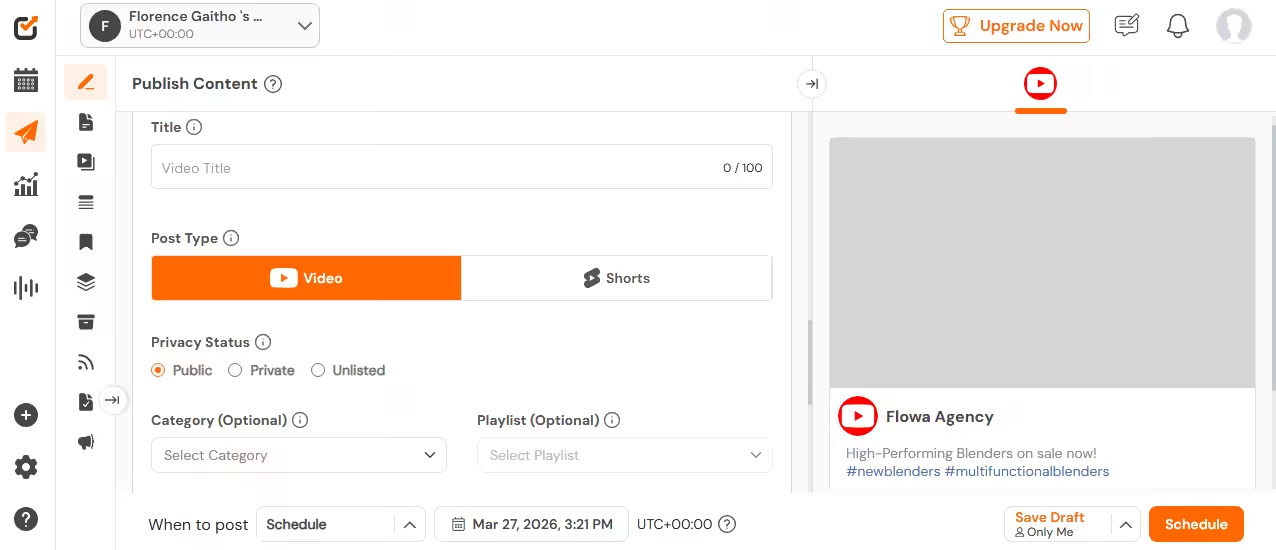
By integrating Youtube analytics softwares into a tool like Social Champ, marketers can react faster to trends, double down on what’s working, and make smarter content decisions.
Conclusion
YouTube in 2026 is bigger, smarter, and more central to digital marketing than ever before.
With over 2.7 billion users and evolving content formats like Shorts and live streams, it’s a platform where brands can’t afford to fall behind.
From deep demographic insights to rising content trends and new AI-powered ad strategies, this blog gives you the roadmap you need to stay ahead.
Use these YouTube stats not just to observe, but to act, to optimize your content, align with what your audience wants, and grow your presence in a competitive landscape.






1 comment
Cameron Stewart
Oh, nice insights! The mind-boggling YouTube stats are a game-changer for understanding the platform’s reach in 2024. A must-read for marketers and creators alike.