I’ve read so many Brandwatch vs Sprout Social comparisons, only to find out that the majority consider these platforms as vastly different tools.
But that’s not the case, according to my experience.
Yes, Sprout Social does provide social media management services, but it can also be used for consumer intelligence (have you seen its social listening?!)
Not to mention, Brandwatch also provides social media management services, so we can’t really say that the tools are used for different purposes.
Short Summary
- Brandwatch and Sprout Social are often portrayed as completely different tools, but they actually compete in the same space. Both offer consumer intelligence and social listening, just at different depths
- Brandwatch is a consumer intelligence platform first, with social management bolted on via its legacy Falcon.io acquisition; it pulls from 100 million+ sources with years of historical data and research-grade sentiment analysis
- Sprout Social is primarily a social media management platform, but it packs serious consumer intelligence features, including social listening across Reddit, Bluesky, Tumblr, X, YouTube and public sources, plus sentiment analysis, competitor analytics, and AI Assist
- The real gap is in social listening depth: Brandwatch offers years of historical data and image recognition for research-grade intelligence, while Sprout Social caps at roughly 30 days but delivers actionable intelligence that drives daily strategy and customer care
- Sprout Social has transparent per-seat pricing starting at $79/user/month with a 30-day free trial; Brandwatch has no public pricing, requires a sales demo, and typically locks users into annual contracts with estimates ranging from $800/month to $50,000+/year
That said, the difference lies in their depth, focus, and what you’re willing to pay for it.
Before we get into it, let me save you some time. If you need the deepest consumer intelligence available, with 100 million+ sources, years of historical data, research-grade sentiment and emotion analysis, go for Brandwatch.
If you need solid consumer intelligence and brand monitoring tools, plus a full social media management suite with publishing, engagement, customer care, and team workflows, pick Sprout Social.
And if you just need basic social listening, along with scheduling, and don’t have an enterprise-level budget, neither of these is for you, but we’ll get to that, too!
Your Budget Will Thank You
Brandwatch vs Sprout Social Compete in the Same Space (Just at Different Depths)
This is where most comparison articles for Sprout Social vs Brandwatch get it wrong. They’ll tell you Brandwatch is for “research” and Sprout Social is for “management,” as if Sprout’s listening is an afterthought. It’s not.
What Makes Brandwatch Different?
Brandwatch is a consumer intelligence platform first, with social management bolted on. It pulls data from over 100 million online sources, including:
- Social platforms
- Blogs
- Forums
- News sites
- Reviews
It also uses advanced AI to analyze the sentiment, emotion, themes, as well as context across conversations.
The most useful part about Brandwatch is that its historical archive goes back years. For instance, if you’re conducting market research or tracking brand perception over a period of time, or even building competitive intelligence reports, Brandwatch will work as a deeper tool.
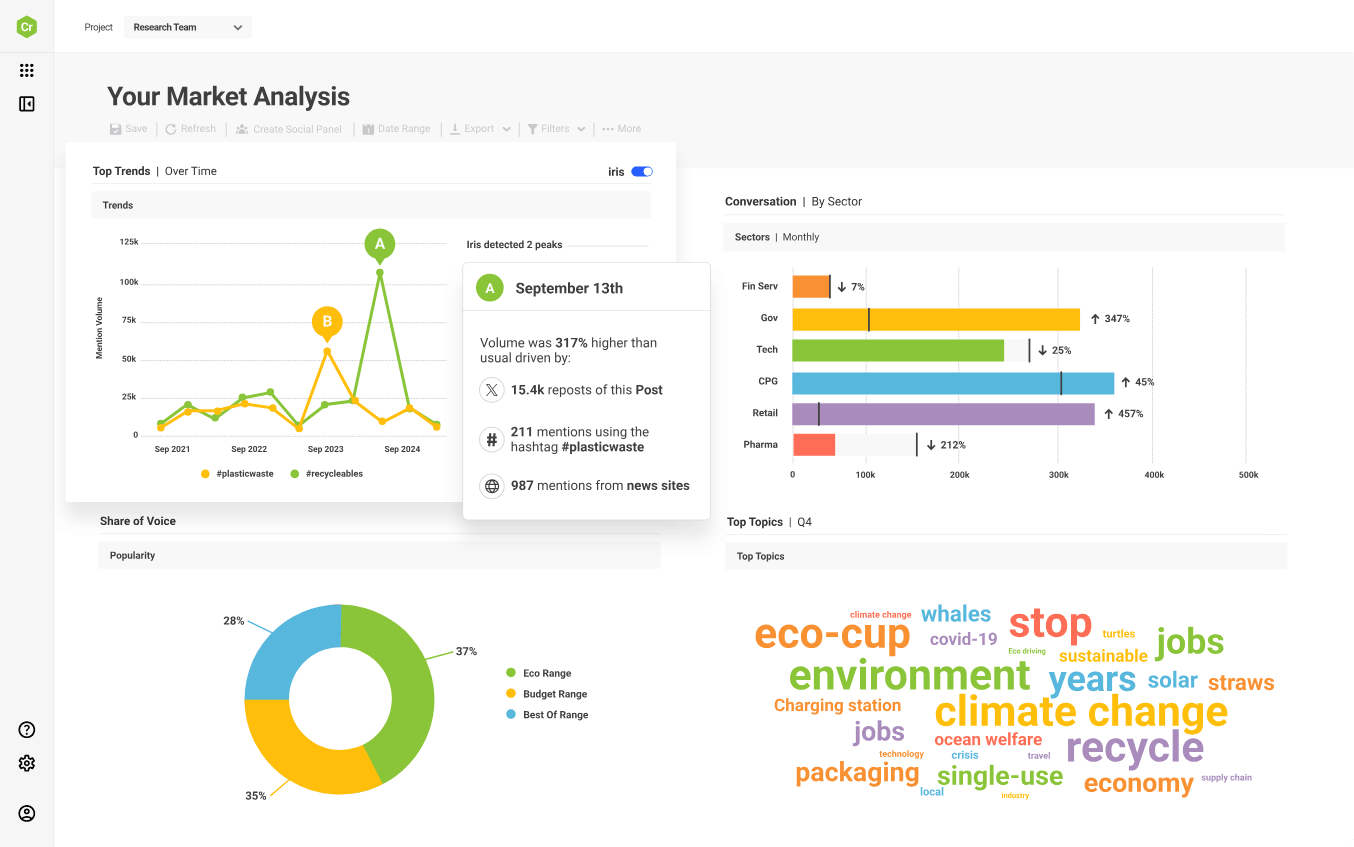
Not to be that person, but here’s something that none of the versus articles talked about. Brandwatch’s publishing and engagement tools are legacy Falcon.io, which was acquired by Cision in 2019 and merged into Brandwatch in 2022.
So, the content calendar, inbox, and approval workflows you see in Brandwatch are not natively built by the same people who built Brandwatch. Instead, it’s a separate platform bolted on.
That being said, it does work well, but for some, it feels like an afterthought because, well, it kind of is.
What Makes Sprout Social Different?
Sprout Social, on the other hand, primarily falls into the social media management platform category, but it has serious consumer intelligence built in.
It’s social listening, in particular, checks for mentions across:
- Bluesky
- Tumblr
- X
- YouTube
- All public sources
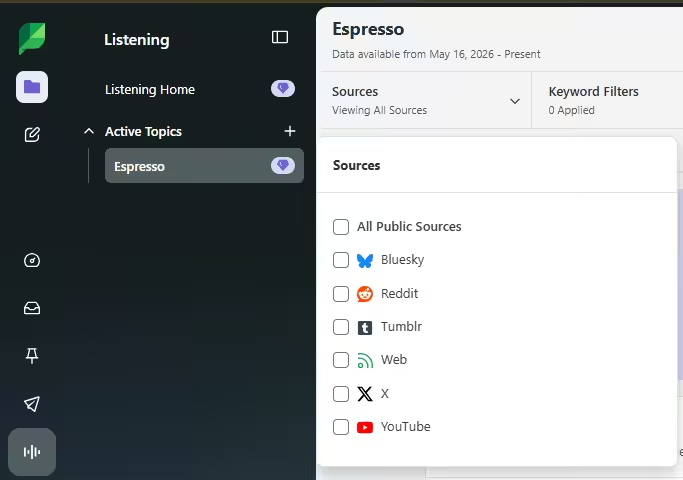
The results are also quite comprehensive. You get sentiment analysis (P.S., you can use the AI Assist to organize and interpret this data!), keyword tracking, message classification, and AI Assist.
Plus, you’re also introduced to competitor analytics, cross-network performance tracking, and review management across App Store, Google Play, Facebook, Google Business Profile, Trustpilot, Tripadvisor, Glassdoor, and Yelp.
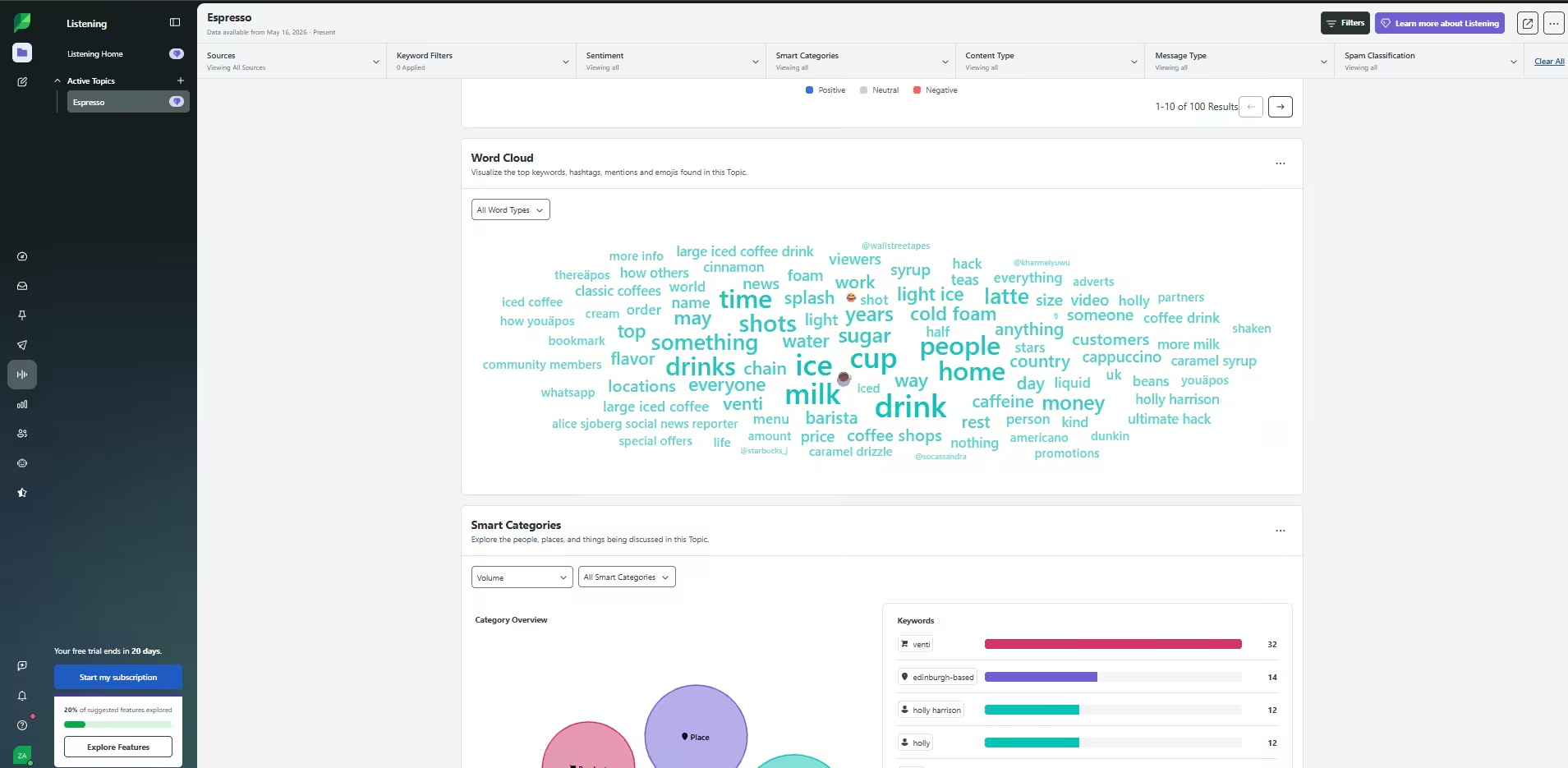
In addition to social listening, Sprout Social also has astonishing social media management features, including:
- Social inbox
- Publishing (or scheduling) (so you can post to all social media at once!)
- Ticket management (called “Cases”)
- Analytics (with white-label reports)
- Custom bots
- Internal team collaboration
- Review management
Now, unlike Brandwatch, Sprout Social’s tools do not feel “bolted on”. They are designed with intention, and they feel like they’re native to the tool.
That being said, Sprout Social’s listening (or consumer intelligence) may not be as comprehensive as that of Brandwatch. You only get 30 days of historical data and a narrower source breadth.
But calling it ‘light’ would be selling it short. For many teams, Sprout’s listening is deep enough that they never need a second tool.
Brandwatch vs Sprout Social (Major Differences and Similarities)
The real question isn’t, “Do I need intelligence or management?”
It’s “How deep does my intelligence need to go, and what else do I need the platform to do?”
To make your decision easier, I’ve created this little table to help you compare the two tools side-by-side.
| Feature | Brandwatch | Sprout Social |
|---|---|---|
| Primary Use Case | Deep consumer intelligence and research-grade social listening | Social media management, consumer intelligence, and customer care |
| Social Listening Depth | 100M+ sources, years of historical data, sentiment + emotion + theme analysis | Solid. Sources include web, Reddit, Bluesky, Tumblr, X, YouTube, public sources; sentiment, keywords, message classification; ~30-day historical data |
| Publishing/Scheduling | Basic (legacy Falcon.io) | Advanced: you get a visual calendar, bulk scheduling, and multi-layer approval workflows |
| Engagement/Inbox | Limited | Smart Inbox with message routing, response templates, CSAT tracking, case/ticket creation |
| Analytics | Strategic. You get trends, share of voice, brand health, demographic analysis, and image recognition | Operational + intelligence. You get cross-network performance, competitor analytics, paid content analytics, customer care metrics, and white-label reports |
| AI Features | Advanced insights, image recognition, trend detection | AI Assist for content generation, sentiment analysis, optimal send times, and listening data analysis |
| Ease of Use/Learning Curve | Steep; it’s built for research analysts | Moderate. It includes loads of tutorial videos and guides. |
| Free Trial | No. A demo is required via a sales call | Yes. 30-day, all-access free trial, with no credit card required. |
| Pricing Model | Custom/enterprise. There’s no public pricing, and annual contracts are typical | Transparent per-seat tiers start at $79/user |
| Best-Fit Team | Enterprise research teams, analysts, large orgs with dedicated insights budgets | Social media teams, agencies, mid-to-large brands needing management + intelligence + customer care |
Featured Article: Sprout Social Reviews
Social Listening (Where the Real Gap Is)
Let’s compare Sprout Social vs Brandwatch for social listening, as this feature is what will drive your decision.
Tools like Brandwatch is super research-oriented. Its platform archives data from 100 million+ online sources, and gives you years’ worth of historical data. You can analyze sentiment alongside emotion, themes, and context, and you can run demographic analysis.
It also lets you use image recognition to track visual mentions of your brand. Plus, you can build custom dashboards that would make your data scientists weep with joy.
Essentially, if you need to answer questions like, “How has consumer perception of sustainable packaging shifted in the APAC region over the last three years?” Brandwatch can actually answer that.
On the other hand, Tools like Sprout Social listens and acts. It monitors the web, Reddit, Bluesky, Tumblr, X, YouTube, and public sources.
It tracks sentiment, related keywords and hashtags, message types, and spam classifications. Its AI Assist analyzes the listening data for you.
You can create custom bots for customer care, shopping, lead generation, and content discovery without coding.
Not to mention, you can manage reviews from App Store, Google Play, Facebook, Google Business, Trustpilot, Tripadvisor, Glassdoor, and Yelp, all from one inbox.
But Sprout Social’s historical data is limited to roughly 30 days, and its source breadth, while wide, doesn’t match Brandwatch’s archive. Where Brandwatch gives you research-grade consumer intelligence, Sprout gives you intelligence that drives daily social strategy, customer care, and PR response.
So, if your job is to manage daily operations, respond to customers, publish content, track competitors, and report on performance, while staying on top of brand sentiment and industry trends, Sprout’s intelligence is probably sufficient.
But if you’re a dedicated research team, a large enterprise, or an agency building super comprehensive competitive intelligence for clients, you’ll need a giant like Brandwatch.
Stop Overpaying for Listening
Pricing and Cost Transparency
Now, let’s talk numbers! When comparing Brandwatch vs Sprout Social for enterprises, this is where your budget might make the decision for you.
How Much Does Sprout Social Cost?
Sprout Social has transparent, published pricing. It goes like:
- Essentials, which costs $79 and has 1 user. In this plan, you can manage 5 social accounts.
- Standard, which costs $199 and has 1 user. In this plan, you can manage 5 social accounts.
- Professional, which costs $299 and has 1 user. In this plan, you can manage unlimited social accounts.
- Advanced, which costs $399 and has 1 user. In this plan, you can manage unlimited social accounts.
- Enterprise, which is custom and has your pick of users. In this plan, you can manage unlimited social accounts.
The great thing about Sprout Social is that you know what you’ll have to pay for each plan before you access the tool.
Plus, you get a 30-day free trial for any plan. It’s an all-access trial, which means you get to actually play around with the tool to see if it’s right for you.
Featured Article: Sprout Social Pricing: Plans and Hidden Costs
How Much Does Brandwatch Cost?
Brandwatch is an exclusive tool, and sometimes, that means that the pricing is not publicly available.
If you do want to know how much it will cost, you’ll have to book a call with its sales team, as you’re looking at custom quotes and annual contracts.
Based on user-reported estimates, you’re looking at roughly $800–$2,000/month for basic listening and analytics, $3,000–$10,000/month for the full suite, and enterprise deals that can exceed $50,000/year. But these are estimates! Your actual quote depends on data volume, number of users, and how good your negotiation skills are.
I have to be transparent here. I have used and tested Sprout Social, so I know its pricing and feature set firsthand.
Brandwatch, however, requires a demo call to access the platform, so my understanding of its interface and day-to-day usability comes from studying online sources and user reviews.
The other thing to know: Brandwatch typically locks you into annual contracts. Some users on Trustpilot have reported being stuck in 12-month contracts, even when the tool wasn’t working for their workflow. That’s a risk you don’t really have with Sprout’s monthly billing on lower tiers.
Featured Article: Brandwatch Pricing
A More Affordable Option for Basic Social Listening (Social Champ)
Look, both Brandwatch and Sprout Social are enterprise-grade tools with enterprise-grade price tags. If you’re a small business or even an agency that does not need all that, you do have other options.
One of the options is Social Champ. This is a great scheduling and publishing tool that comes with intelligence features like social listening and competitor analysis.
Plus, you also get:
- Scheduling and publishing
- White-label reporting and analytics
- Review management
- Social inbox
- AI suite
- Team collaboration
This tool also offers pay-as-you-grow plans, along with flat-rate bundles, which means you never have to pay more than what you actually need.
Its social listening is also quite great. You can monitor mentions on:
- YouTube
- Bluesky
You can also analyze the sentiment and download a full-fledged listening report in PDF, CSV, and PPT formats.
With social listening, Social Champ’s prices start at:
- $8/ month/channel
- $47/5 users/ 12 social accounts.
- $119/unlimited users/ 30 social accounts. This plan also comes with add-ons for accounts. You can add another account for $3/account
Skip the Demo Call
Conclusion
Brandwatch and Sprout Social absolutely belong in the same conversation. Both do consumer intelligence. Both do social listening and sentiment analysis. The difference is depth, focus, and what else you need the platform to handle.
Essentially, you can choose Brandwatch if you need really, really in-depth consumer intelligence, and if you have the budget and analysts to extract value from it.
You can go with Sprout Social if you need solid consumer intelligence plus a full social media management suite.
And if neither price tag fits your reality, there’s always a middle ground (Social Champ) that doesn’t force you to compromise on features!
Featured Article: Sprout Social vs Social Champ
FAQs
1. What Can Brandwatch Do That Sprout Social Can’t?
2. What Can Sprout Social Do That Brandwatch Can’t?
3. How Does Brandwatch Pricing Compare to Sprout Social?
4. Is Brandwatch Worth It?
5. Is Brandwatch an AI Tool?
6. Who Are Brandwatch’s Competitors?